Search This Blog

Thursday, June 4, 2020

6/2/20 Report - Frederick Douglass, Fort Pierce, and Turtle Trail Beaches. Gold Lion Pendant Find. Looters Get Rolex Watches.


Written by the TreasureGuide for the exclusive use of treasurebeachesreport.blogspot.com.


Fort Pierce South Jetty Beach.

I took a look at a few beaches Monday.  You can see a couple of them here.


Frederick Douglass Beach Monday.

We have summer beaches now, and it is hot so people are getting in the water more.


Frederick Douglass Beach Near Low Tide Monday.

John Brooks beach looked very much like Frederick Douglass.


Frederick Douglass Beach Monday.

I managed to find a small gold lion pendant.


Gold Lion Pendant.


Tuesday Morning I visited Turtle Trail.  Here is what it looked like.


Turtle Trail Tuesday Morning.

Tuesday the weather was the kind I like - cloudy and rainy.  No crowds - just nature.

There were a few very small cuts and dips.

Turtle Trail Tuesday Morning.

Down around the low tide swash area there was about a foot of fine sand over a layer of coarse shells.  The shell layer contained miscellaneous light trash and a few pennies and things like that.  There were deeper objects, but they were difficult to dig out.

---

About a month ago I did a couple posts on Rolex watches.  There are now a lot of new stolen ones out there.

Last night looter's took $2.4 million worth of Rolex watches from a looted Soho store.

Here is the link.


By the way, if you are wondering why the police aren't doing much to stop the rioters, looters and Antifa trouble makers, it is because a lot of them are from well connected political families that support Antifa.  For example, the son of former VP candidate, Tim Kaine, is a member of Antifa, and Mayor de Blasio's daughter was recently arrested during the riots.

---


We have a new tropical storm in the Gulf.

Source: nhc.noaa.gov

It looks like it will head towards Louisiana.  I doubt that it will affect us much.

Happy hunting,
Treasureguide@comcast.net


6/1/20 Report - Trade and Archaeology of the Manilla Galleons. Porcelain. Beach Cusps or Scallops.


Written by the TreasureGuide for the exclusive use of treasurebeachesreport.blogspot.com.

People find blue and white shards on the Treasure Coast 1715 wreck beaches and wonder if they might be Kang Xsi.  I get a lot of questions about that and in the past have posted some information about Kang Xsi, including  tips on identification.  Below are two intact Kang Xsi (various spellings) cups that sold in the recent Sedwick auction for $700 plus buyer's premium.  We usually just find shards on the beach, but they can be worth a little too, especially when attractively mounted.

Here is the Sedwick lot description for the two cups.

Intact blue-on-white Chinese porcelain cup with handle, Kangxi period, ex-HMS Winchester (1695), very rare provenance and condition. 72 grams, 2-1/2" tall and 2-1/8" in diameter. A lovely little piece with nothing missing (the handle manufactured separately and applied or possibly re-applied after glazing), the glaze worn away but with clear flowers in vase on balcony design on exterior, highly desirable as the only intact specimen found on this rare wreck. From the HMS Winchester (1695), with photo-certificate.


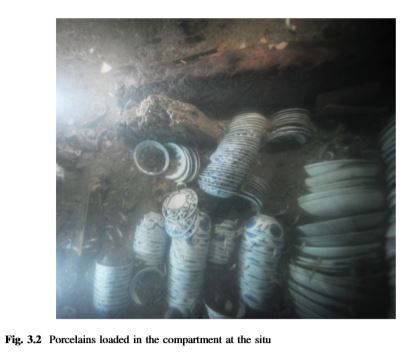
I found a good book with a lot of information on Chinese porcelain and the Manila galleons.  The title is Archaeology of Manila Galleon Seaports and Early Maritime Globalization, Part II.

That resource contains tons of photos, including the photo below of a wreck still containing a cargo of Chinese porcelain.

Source: Academia.edu link below.


That photo reminds me of the fellow who found a stack of plates recently exposed by new erosion to a wreck beach and didn't pay much attention to them. When he learned they could be valuable, he returned to find them, but couldn't.

During the sixteenth to nineteenth centuries, the Spanish navigators established and operated the Manila Galleon maritime route which connected East Asia and New Spain in the American continent. The galleons sailed across the Pacific via the hub seaports and trade centers of Manila in the Philippines and Acapulco in Mexico, forming a prosperous sea route for more than 250 years. This pioneering navigation of pan-Pacific regions promoted early global maritime trade as a new maritime Silk Road between the East and the West...

The Spanish conquest of the Philippines began with the arrival of Ferdinand Magellan in March 1521 (Pigafetta 1969). When Magellan was killed in April 27, 1521 by a local chieftain in the island of Mactan by the name of Lapu-lapu, the remaining Spaniards hastily left and went back to Spain. It was not until exactly 44 years after the death of Magellan that another expedition arrived in the Philippines (Cebu) under the command of Miguel Lopez de Legaspi, with specific instructions from the King of Spain to find the return route from Manila to New Spain (present day Mexico). The discovery of the tornaviaje or the return journey from Manila to Acapulco by Fray Andres de Urdaneta, Legaspi’s pilot and navigator in 1565 completed the maritime route that was later utilized by the Manila-Acapulco Galleon Trade (Schurz 1985). The first few galleons left from Cebu until Legaspi transferred his capital to Manila, leaving Cebu in economic disarray (Fajardo 2018). The galleon trade represents one of the earliest manifestations of economic globalization where Asia, the Americas and Europe were linked together through maritime high ways. 


The Galleon trade fostered both economic and cultural exchanges between the Philippines and Mexico, which can be observed up to this day (INQUIRER.net US Bureau 2017). The Manila-Acapulco galleon trade route was operational for 250 years (1565–1815) where merchant ships traversed more than 18,000 km across the Pacific Ocean from Manila to Acapulco and vice versa. At the western terminus, Manila became the world’s premier entrepot during the sixteenth and seventeenth centuries that linked peoples, cultures and material goods between Asia and the Americas (Schurz 1985; Fish 2011)...

I highly recommend reading this lengthy document.

Here is the link.


Not only did the Manila galleons distribute items that ended up on the 1715 Fleet and Treasure Coast beaches, but Spanish colonial items also ended up in the ports of Asia.

Source: See academia.edu link above. 

---

In the past I received questions about how scallops or cusps are formed on the beach.  Here is an illustration that explains that.


---


Gold has been doing well.


The stock market is up this morning, which is really a statement for all of the positive things going on with economy, space exploration and pharmaceutical industry.


The surf is small today but will increase tomorrow.  The wind has already changed.

Source: MagicSeaWeed.com.

TreasureGuide@comcast.net


5/30/20 Report - Lead Coin. How Sand and Objects Move On A Beach. Crosses, Medallions and Other Religious Artifacts.


Written by the TreasureGuide for the exclusive use of treasurebeachesreport.blogspot.com.


One of the interesting odd items in the Sedwick auction yesterday is the lead coin shown above.  As you can see, it was listed as lot 1201.

You don't often see lead coins, but that Nicaragua 10 peson coin is one that has an interesting history.

fascinating relic from the rebellion of 1927-33 that pitted forces under revolutionary leader Augusto Cesar Sandino against the U.S. military, Sandino eventually being assassinated but still revered today as a national hero and symbol of resistance to U.S. domination in Central America. Tokens like this one were exchanged for goods from local merchants.

If you dug up a lead coin you might think it is some kind of token, weight or fake.

---

I've been thinking of doing this post for over a month now, but it isn't an easy one and I still don't have it together.   The topic is very complex and involves a number of factors and interrelationships, but I'll do my best to make it clear, which means keeping it simple to some extent.

I previously did a number of posts on the movement of sand and other objects.  Different objects move differently depending upon a variety of factors, and an object such as a coin can move in a variety of ways.

The main reason we are interested in the movement of sand is that it can cover or uncover the the types of objects we look for.  The uncovering can occur naturally, which is necessary for the beach detectorist, but if you are working a salvage lease you can move the sand using blowers.

What I want to describe today is the relative movement of sand and other objects.  First I must repeat one thing that is often neglected - it is not just about weight.  The density of the object - not it's weight - is important, but it's shape is also important.  A flat thin piece of copper will be washed around by the water differently than a coin of the same weight.  You'll frequently find small thin pieces of copper washed up and laying on or near the surface of the sand when you can find little else.  And an oval lead sinker will move around very differently than a flat or triangular one.


To get the basics, I'd recommend studying the following table shown above and a previous post in which I explained it.

Here is that link.


So a certain amount of force is required to move the sand and a certain amount of force is required to move an object such as a coin.  The amount of force required to move sand will typically be less than that required to move the coin.  Therefore, sometimes the sand will move, but not the coin.  The sand might then uncover the coin or let it sink down to the surface vacated by the sand.

In a previous post I mentioned five ways that coins move, so that can get complicated, however coins and items such as coins will move less often and not quickly as sand.  So the thing that is important is relative movement.

Imagine the situation in which the beach sand moves but the coin remains relatively stationary.  The coin will be uncovered and if the sand continues to move without the coin moving much, the coin will sink down to the new lower surface of the sand where it can stay until it is covered again.  That is not an unusual scenario.  One important thing to remember is that the coin will remain basically stationary as long as it remains covered.  If there is enough force the coin can move when the sand moves, but in most cases it won't move as much as the sand.

If you sketched a Christmas tree and took the side on one side, that would be a fairly typical coin movement pattern over the years.  Every time there is erosion it might drop with the sand surface and drift a little towards the surf.  It might get covered from time to time but seldom get washed back up.  Usually it would stay at its current position until it is uncovered again.

A ring, because of its shape, will get washed up less often than a coin because of its shape.  There is less surface area for the force of the water to act on.  Once either of them reaches a deep level they will seldom be washed up.  It would take a rare event for that to happen.  And once either reaches shelter in a rock crevice, it would be extremely rare for either to be washed up.

Where a lot of the action happens is where the wave breaks.  That produces a lot of turbulence and lifts sand, rocks and other things that can then be pushed up the slope by rushing water.  Again, it will take a lot to wash a ring up the slope because the lack of flat surface area.

What makes things especially complicated is the continually changing force of the water as it comes in and goes up the slope and then descends back down the slope and all of the interactions.  It would be much easier to figure out if the water simply flowed in a continuous stream, but that is far from what we are dealing with.

---

The Sedwick auction concluded today.  The last session included a variety of less expensive lots, including some rather large groups of coins, clumps, paper money and mounted coins.  Among the items were the following group of miscellaneous religious items.


Here is the lot description.

Lot of twelve crosses and religious medallions and other items in base metals, various periods (1600s-1900s). 47.95 grams total, 1/2" to 2". Cool little collection of objects, from a three-masted ship to a functioning miniature spur to various medallions and simple crosses to two crosses (one ornate though incomplete) with inlaid cabochon emeralds. Great for further study.

Some of the lots in the final session went unsold, but I thought the auction did much better than I expected.  For the most part, bidders were not deterred by the economic downturn.

---

It looks like we will have a two or three foot surf for a couple of days and then a possible increase.

Happy hunting,
TreasureGuide@comcast.net