Search This Blog

Thursday, April 7, 2022

4/7/22 Report - Signs, Layers, Hot Spots, And the Entire Panorama of the Beach. Analysis and Synthesis.


Written by the TreasureGuide for the exclusive use of the Treasure Beaches Report.

Eroded Dunes Showing Various Layers.
Photo by Joan T.

You might remember the song by the Five Man Electrical Band - Signs.  Here are a few lines to refresh your memory, if you are old enough.

Sign, sign, everywhere a sign
Blockin' out the scenery, breakin' my mind

Do this, don't do that, can't you read the sign?

Everywhere are signs.  It doesn't matter whether you are coin shooting or hunting bottles.   I'll talk about both.

In  my recent bottle hunting, there are some better spots where I have been finding some nice old bottles.  You will see some things that will tip you off to those spots that have been producing.  Those spots might move a few or many yards north or south on any particular day, depending upon the changing directino of the waves, or they might disappear altogether.

Here are a couple of the more obvious signs.  At one location the roots of an Austrailian pine are sicking out.  The bottle spot is usually just in front of that.

It isn't always easy to tell how much sand has been moved, but if you have some stationary landmarks, it is easier to judge how much sand has moved.

Another common sign I have been seeing is stairs where the sand has been washed away from the bottom so that the bottom stair is several feet in the air.

When walking along the beach looking for bottles, you might see small pieces of broken glass or other materials that signal that you might be getting close.  As teh pieces get larger, you are getting closer to good conditions.   You can walk a long distance and see nothing but sand, and then start to see small pieces of glass littering the ground.  Whole bottles might not be exposed, but the small glass is a good sign you are getting closer.

The same thing happens on the beach when metal detecting for coins.  There will be some signs.  Maybe you'll start seeing shells or rocks in some areas.

If you look at the dune face in the photo at the top of this post, you'll see that the dunes are made in layers.  During different events different layers were laid down.  Some events will create layers of fine sand, and at other times when the water is moving more forcefully, shells, rocks or other things will be dropped in a layer.  Small shells will be piled up when there is enough water force, and then maybe larger shells when there is more force.

You'll see the same thing sometimes in the face of the cut.  You might see layers of various kinds of sand.  Maybe black and layers, layers with shells, and layers with gravel or modern debris such as cans or plastic bags.  Those can be significant signs.

When viewing the entire beach panorama, you'll see a rolling landscape with some dips, hills, and maybe some cuts and various assorted surface objects.  It is all significant, and by looking at the overall picture, you'll get a good idea of the hot and not so hot spots.

By using your metal detector and digging a broad range of types of objects, your understanding of the classification or stratification of objects will be increased.  The metal detector allows you to get a bit of a subsurface view as well as a surface view.

The view extends from the dune face into the water.  You can see the sand bars and where the waves are crashing, as well as any dark deeper areas.  It all forms a picture of what has been going on, and when you analyze that, you'll be closer to knowing where the coins are likely to be.

There are two stages though.  There is analysis: breaking things down into the component parts, and there is the synthesis, putting it altogether in an overall picture.

Over the years I've done many related posts.  I'd advise maybe going back to the old Treasure Beaches Report and reading some of the many relevant posts.  
\

I continue to add to my knowledge every time I go out, just as you will.

Good hunting,
Treasureguide@comcast.net


Wednesday, April 6, 2022

4/6/22 Report - Mid-Sixteenth Century Spanish Sites and Artifacts of Greater Florida: A Study. Roman Sword Found Near Oak Island.


Written by the TreasureGuide for the exclusive use of the Treasure Beaches Report.


I found a good article: Interpreting Spanish Artifact Assemblages in the Mid-Sixteenth-Century Southeast:The View from the 1559-1561 Tristán de Luna Settlement on Pensacola Bay by John E. Worth of the University of West Florida.

Here is the abstract.

Sixteenth-century Spanish artifacts are uncommon but widespread finds in the Southeastern United States, and documented assemblages have been variously used by archaeologists either as secondary indicators of the presence of passing Spanish explorers, or also as evidence of director indirect Spanish trade. The vast majority of such artifacts are found as grave goods within Native American villages or burial sites, apart from a handful of well-documented Spanish colonial settlements and encampments. Archaeological investigations at the recently-discovered1559-1561 Tristán de Luna settlement provide a remarkable opportunity to examine a substantial though short-lived residential Spanish assemblage dating to this same era.

Below is a cool map showing Spanish and French settlements and forts of Greater Floria in the century.


Most of those sites are evidenced by artifacts that have been studied.  Notice the Treasure Coast site, which is one that I recently mentioned.  

These are obviously early sites that will often produce diagnostic artifacts from the period.  While a previous study that I mentioned focused on artifacts that were indicative of early 16th century sites, this study looks at the difference in the type of artifacts from residential versus shorter-term or pass-through sites.

Here is another interesting paragraph.

Relatively extensive documentation for gifts brought and distributed on early expeditions or traded and gifted during the early mission period in Florida provides a clear picture of the normal items provided by Spaniards and consumed by Native Americans. The most frequent items documented in detailed and voluminous accounting records over the course of two decades (1595-1616) in the early Florida mission period included strings of glass beads, sleigh bells, buttons, fixed-blade knives, iron axes and hoes, and woven blankets, along with a large and diverse range of raw cloth, thread, and finished clothing items including hats and shoes, sometimes far more expensive than other items distributed (Redondo Villegas 1602a-c;Sotomayor 1616; Worth 1998:126-143). To this can be added a range of other items that were given out much less frequently, including mirrors, scissors, adzes, and raw iron and lead...

This study has some interesting charts as well as a lengthy bibliography that you might find helpful.

Here is the link.

(99+) Interpreting Spanish Artifact Assemblages in the Mid-Sixteenth-Century Southeast: The View from the 1559-1561 Tristán de Luna Settlement on Pensacola Bay | John Worth - Academia.edu


----

Sword Found On Shipwreck Off Oak Island

... A Roman ceremonial sword off Oak Island, located on the south shore of Nova Scotia, Canada, radically suggesting that ancient mariners visited North America more than a thousand years before Columbus. While the announcement was largely met with surprise and excitement, many have also questioned the authenticity of the artifact. Here we explore the origins of the mysterious Roman sword...

This isn't a new discovery. The sword was found over fifteen years ago. And not by any of the current searchers.

The Roman sword found off Oak Island is believed to be part of a rare set of votive swords. Four similar swords having been recovered and verified, now in private collections and museums, including the Museum of Naples, Italy, which issued cast iron replicas of the sword. Many replicas of these rare swords can now be found on websites such as eBay and Amazon...

I saw last night that they are now searching for shipwrecks around the island. I showed a map a few years ago showing how many shipwrecks are in the area.

Surprising to me is how little they have actually found on the island, despite all the time and effort put into the search.

The sword, like so many other things these days, is of questionable authenticity.

Here is the link for more about the sword and shipwreck.

Unraveling the Origins of the Roman Sword Discovered Off Oak Island | Ancient Origins (ancient-origins.net)

---

The main thing on my mind this morning is the idea that there are things to be found everywhere.  Some places have more things and some places have more valuable things, but you can find things almost anywhere.  

There is no big change in the surf predictions.

Good hunting,

TreasureGuide@comcast.net

Tuesday, April 5, 2022

4/5/22 Report - Artifacts Diagnostic of 16th Century Contact Period Sites. Important Artifact Found Unearthed by Fallen Tree.


Written by the Treasureguide for the exclusive use of the Treasure Beaches Report.

Silver Contact Period Diagnostic Artifacts.
Source: See Academia.edu link below.


Those are the first two paragraphs of the article.  Below is the link if you want to read the rest of it.  

The silver artifacts and the chevron beads shown here are two types of diagnostic artifacts suggesting an early period. 


Chevron Beads From Archaeological Sites.
Source: Academia.edu link below.

Here is the link for the rest of the article.

(99+) Artifacts of exploration: archaeological evidence from Florida | Jeffrey M. Mitchem - Academia.edu

It would be easy to mistake one of those silver beads for something modern and less interesting.

----


A Royston-area man turns up Indigenous artifact in his yard.  The object seems to be a war club and has found a home with K’ómoks First Nation.


Sandstone War Club Found Under Fallen Tree in Homeowner's Yard.
Source: See link below.


Mark Lake was cleaning up his Royston-area yard last April when he came across an object that looked like it had been around a while.

He been working in a wooded area after an old maple tree had blown over. Over the years, he’d found lots of junk before though never anything of historic value, but what he turned up turned out to be an Indigenous artifact.

“I picked this object up, sticking out from underneath a young maple, and didn’t think anything of it,” he said.

At first, he thought it was a type of industrial waste. Once he got around to cleaning it, he realized it was some kind of carving....

Here is the link.

Royston-area man turns up Indigenous artifact in yard – Comox Valley Record

I often check around uprooted trees.  Often there is nothing, but sometimes you will find something interesting.  I recently reported on the Seminole Mild Co. bottle that my wife found while digging under a Pepper tree.

---


Source: magicseaweed.com.

I can't remember a time when we had such a long period of one foot surf.

The water on the lagoon hasn't been that smooth.

Good hunting,

Treasureguide@comcast.net


Monday, April 4, 2022

4/4/22 Report - 16th Century Blockhouse in Saint Lucie County. Coin Finds. Dug Iron Railroad Plates.


Written by the TreasureGuide for the exclusive use of the Treasure Beaches Report.

Coins Found by Dan B.

Dan B. found the coins shown above at an inland construction site.  Here is what he said.

Good inland hunting recently at one of my favorite spots. Got turned up by some construction.
My first opportunity that I caught it in the action and was able to benefit inside that window.
So far score is Me-1 -  Sod and pavement-5.  It hurts to drive up to a spot that you have waited for them to tear up for years only to see sod and concrete.

Dan wrote up some interesting treasure hunting experiences that I was thinking he might share some day.

---

It is believed that the name “Saint Lucie” was first introduced to the area by the Spanish.  In 1565 Fort Santa Lucia was built by the Spanish, at the Jupiter Inlet.  Construction for this fort began on December 13th, the feast day of the Roman Catholic Saint Lucia.  Pedro Menendez de Aviles established a colony in 1567 called “Santa Lucia” somewhere between Vero Beach and Stuart.  Old Spanish maps identify the area as Santa Lucia.

The current Saint Lucie County was known as East Florida in 1810.  In 1821 the area was renamed St. Johns County.  St. Johns was split into several counties in 1840 and this area became Mosquito County.  Ten years later the Mosquito County area is slashed into two new counties and our area becomes St. Lucie for the first time... 

That is from St. Lucie County History | St. Lucie Historical Society (stluciehistoricalsociety.net)

According to a personal communication I recently received from author and researcher Laura Strolia, there are historical documents indicating that blockhouses were built along Florida's southern coast between 1566 and 1568.  It appears that one of those was in the Jensen area.  A few years ago in this blog I reported on a cannon ball found at a site very close to the proposed site of one blockhouse.  Interesting!

I eagerly await the publication of Laura's most recent book.  Maybe you've already read her previous book,  The Marigalera of the 1715 Fleet.  

---

I don't know if you pay much attention to your dreams, but it seems to me that they can often be the key to solving problems.  That is nothing new to the psychiatric community, but it can be a pain, if upon awakening in the middle of the night, your mind is high gear.  Despite the inconvenience, dream analysis can be helpful.  

---

Lately I've been doing more bottle hunting than metal detecting.  It is one of those times when it seems that the old bottles have been popping up, and that doesn't happen all the time.  Like with metal detecting, there are times that are productive and others that are not so productive.  And like they say, "Make hay while the sun shines."  You never know what you are missing, and it is a shame you can't do everything at once.  You have to make decisions and you only discover the path you choose.

For me, hunting surface bottles has several advantages.  First, I don't have to get in the car and drive anywhere to do it.  I just take a little walk.  It is fortunate that I have such good hunting so close to home.  

Another thing I like about hunting local bottles, is the local history, which seems even more personal because it the area where I have lived for a good number of years. 

Bottle hunting also provides some good clues for metal detecting.  If you find old bottles, you know that the area also has to have some old coins and artifacts of a similar age.

It seems I've been on the bottle trail, and each time I find a nice old bottle, it gets me more interested to find out what else is there.  I'll get back to doing more beach metal detecting before long.  In fact, I've done some that I haven't reported on yet.  Nothing great though.

---

A few days ago I dug eight of these heavy iron railroad plates,  I'm still looking for a way to make something out of them without doing any welding.  The typical size is 11 inches per 8 inches.

Dug Iron Plates
\
They do make a decent fire pit hearth (below).


Any ideas?

I hope I can find a three more sections of railroad track.  I want to make another bench.  The first one I made from track sections worked out great.

---

A one foot surf is predicted for the next week.  

Good hunting,

TreasureGuide@comcast.net


Sunday, April 3, 2022

4/3/22 Report - The Radar Wreck of Melbourne and Some Diagnostic Artifacts. Mystery Item. Cleaning Some Stoneware.


Written by the TreasureGuide for the exclusive use of the Treasure Beaches Report.

Silver Platter From "Radar Wreck"
Source: See SeaFarerExplorationCorp.com link below.

Some artifacts are simply more helpful than others.  They provide important diagnostic information.  The silver platter (shown above) found on the site of the "radar wreck" in 2004, bears an inscription that reads: Dona Juana Isabel de Chaves Espinosa de los Monteros.  That is some very good information.  Starting with that inscription, additional research helped identify the ship it came from. The research revealed consignments made by a Don Joseph de Espinosa de los Monteros, which eventually led to the identification of the name of the ship that carried the platter.

Another important artifact found off Melbourne Beach was a pistol.  That artifact also carried some important information.  It showed a name and date Ramirez and 1709.

Name Found On Pistol From the
Site of the Radar Wreck.

This pistol bearing a name and a date, with further research, also pointed to the name of the shipwreck that lies off Melbourne Beach.

Just last summer some great discoveries were made by John R. and his crew off Melbourne beach.  I suspect they'll find some more this summer.   I'm rooting for John and his crew. 

Below is the link for more about these diagnostic artifacts that helped identify the Radar Wreck as that of the Santisima Trinidad y Nuestra Señora de la Concepción of the 1715 Fleet.

Dr.-Robert-Baer-Melbourne-Beach.pdf (seafarerexplorationcorp.com)

---

Here is an odd screw.  Anyone recognize it?  Notice the odd head.


---

I was working on cleaning the new master ink bottle find, and got a lot of the moss and shells off of it.

I have it soaking in white vinegar now, which will remove a lot of the remaining shells safely.

Partially Cleaned Bourne Master Ink Bottle

As you can see, there are still some shell residue on the bottle, particularly over the label.  I now have that part of the bottle soaking in white vinegar to dissolve that calcium.

---

The surf is going to be nice and smooth for a week or so.  Although the beaches won't be eroding, the small surf will present some opportunities.

Source: MagicSeaWeed.com.

Good hunting,
Treasureguide@comcast.net.


Saturday, April 2, 2022

4/2/22 Report - 18th Century Spanish Storm-Damaged Ship Results in Scotch Marmalade Leading To Recent Find of a 19th Century London Stoneware Bottle On the Treasure Coast.


Written by the TreasureGuide for the exclusive use of the Treasure Beaches Report.


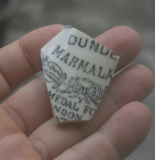
Small But Informative Piece of a Broken Crock.

I've often said that some finds might not be worth much money, but they can still provide valuable information. That was the case with this small piece of broken stoneware that I picked up a couple weeks ago.

I didn't get around to researching it right away, but recently I did the research. Turns out that it is from a Dundee marmalade crock. Here is some of what I learned.

The Dundee Marmalade story begins in the late 1700’s with a small grocery business in Scotland that by the mid-1860’s had grown into a world-wide enterprise.  Back in the 18th Century, a storm-damaged Spanish ship carrying Seville oranges sought refuge in Dundee Harbor. The lot of oranges was sold to James Keiller whose mother, Janet, decided to make marmalade out of the bounty. Thus, the James Keiller Dundee Marmalade Company was born. Back in the day, it was believed that the pieces of orange peel in the marmalade aided in digestion...  (Source: VintageCrossings blog)

Surprise, surprise!  So we have a  story that started with an18th century storm-damaged Spanish ship.  But of course the story doesn't end there.  Years later, the marmalade crock made it to the Treasure Coast where the  marmalade was consumed.     

Below is an unbroken crock something like the one that produced the piece recently found on the Treasure Coast.


I enjoyed learning the story that crosses both centuries and continents leading to the Treasure Coast. Even before I did the research and learned the story behind it, though, I liked ironstone piece enough that it provided the inspiration for another hunt. It provided the extra touch of motivation that got me going on the next hunt.  With the ironstone Dundee marmalade crock still on my mind, I went out to search the same area yesterday (Fri.) afternoon.

Conditions were great for bottle hunting.  The tide was low and the water clear.  I had high hopes, but after a good long walk with very little to show for it,  just when I was about to give up, I finally found something nice as well as a few other borderline keepers.


A Few Finds From Friday.

Nothing very exciting here.  A McCormick and Co. Baltimore bottle (very common).  A nicely shaped but not old bottle, a white marble, a Wink soda bottle, and an ACL 1 Pint Coke bottle.  I don't think I found a Wink bottle before.  

My best find of the day, though, was the large master ink bottle shown on the right below.

New Master Ink Bottle Find (right) Shown With Similar Cleaned Bottle.


That was not an easy find.  Most of my better bottle finds lately have been either almost completely buried and/or covered by moss or seaweed.  I cleaned a lot of the shells and moss off the new find, but it needs a lot more cleaning.  It seems to have the same impressed label as the smaller bottle (found long ago), although I can't see it well yet.  

All I could see of the new bottle was a clump of shell and seaweed.  I managed to get my fingers in the mud and under the bottle before I knew it was a bottle.  Then I carefully lifted it out of the mud.

Below is the label like the one I think I will see when the new find is better cleaned.

Label of J. Bourne and Son Master Ink Bottle.


"J. Bourne and Son" was used first in 1850. The bottle would probably be from the 1850-1880 period.

You can see similar bottles in the Odyssey Marine virtual museum. A lot of these bottles were found on the wreck of the S. S. Republic and are being sold online.


So a piece of an ironstone crock that held a Scotch marmalade originally developed from oranges from an 18th century Spanish ship got me started on a recent Treasure Coast hunt leading to a 19th century London stoneware ink bottle.

I'll get this new bottle better cleaned soon.

---
Source: MagicSeaWeed.com.

Looks like small surf for a while.

Good Hunting,

TreasureGuide@comcast.net

Friday, April 1, 2022

4/1/22 Report - Do You Know The Basics of Your Metal Detector? Developments and Evolution of Interfacing With A Metal Detector.


Written by the TreasureGuide for the exclusive use of the Treasure Beaches 

There are some basic adjustments that you will find on many metal detectors.  They might work slightly differently on different detectors, but there will be some similarities.  

The Equinox metal detector is a very popular beach metal detector, and you will find many of the most common adjustments on the Equinox, whether it is the detector you use or not.  

Let's see if you know what these Equinox icons indicate.  If you use a Minelab Equinox detector, you definitely should know these, but if you use another metal detector, you might still be able to figure out what the icons mean and how to make the adjustments.  Some of the icons might be more intuitive than others.

Below are the icons for the top-level Equinox settings.  If you use an Equinox, you should definitely know what they are.  Take a look at each and see if you can tell what they mean.

You get those settings by pressing the settings button a certain number of times.   First, here is the settings icon.    I don't know how intuitive that one is. A similar icon is used by Microsoft operating systems as a "settings" button.

On the first press of the settings button, you will gain access to the first adjustment. The second time you press of the settings button will see the icon for another adjustment and be able to make that adjustment.  If you press the settings icon seven times, you'll get the option associated with the seventh icon and the associated adjustments.

Below are the seven icons that indicate the seven top-level (basic) adjustments.  

Source: Minelab Equinox Manual.

The first icon is pretty easy.  It think many people would associate the icon with the associated type of adjustment.  The first icon is the noise cancel button.  

I've found the noise cancel option useful and effective.  Doing the noise cancel help a lot when you when you have electrical interference in the area, whether the noise is caused by underground cables, electric lines, cell phone or security systems.  I use it fairly often.  You can also change the frequency, but that can be more difficult and can have negative effects.

Many other metal detectors will conduct an automatic noise cancel operation.  You might not need to do a noise cancel very often at the beach.  You'll more often encounter electrical interference at home or at a park.

The second icon is.......  ground balance.  You can manually ground balance your metal detector, but it is not necessary.  I don't think I've ever manually ground balanced my Equinox, except to test it at home.  On the other hand, I always ground balance the ATX when metal detecting wet sand at the beach.  The ATX is really different than the Equinox, and I use it differently.  When I use the Equinox, I am usually in more of a quick scanning mode, and when I use the ATX, I am probably more intensely detecting a specific area. 

The third icons is the volume adjust.  I seldom adjust the volume on the Equinox, but you might want to pump it up to max if your hearing isn't good or there is a lot of noise in the environment.

The fourth icon is for the threshold level.  The threshold is the level of noise you will hear when there is no signal.  Without adjusting the threshold on the Equinox 600 (not all modes of the 800), the threshold will be 0 in the Park, Field and Beach modes.  The range of threshold levels is 0 - 25.  0 is silent. 

If you just use the default Equinox threshold setting, that will probably be ok in most situations. On other detectors, you might more often want to adjust the threshold.  The threshold level can be really important when using some detectors.  A threshold too low or too high can really affect performance.

The fifth icon gives you access to the target tone adjust.  I won't get into that one now.

The sixth is the accept/reject button.  It allows you to discriminate specific items.  You will want to practice with that one before using it in the field.  Until you get it down, you can use the tones or conductivity numbers to discriminate.  I've talked a good bit about the conductivity numbers in the past.

And the seventh, and last, top-level adjustment is the recovery speed.  That is another one that should be practices a lot before using it in the field.  Nonetheless you should be aware of what the icon indicates, and know something about the adjustment.

You might want to do a FP preset when you start each session, otherwise it is possible to carry over adjustments from previous settings that are no longer the best.

I am not trying to teach you to use the Equinox.  I am only trying to provide some discussion of the most basic icons and options so you will have a basic level of familiarity.   You will be much better off if you understand these basic icons and the basic adjustments your detector will allow, no matter what metal detector you are using.

You might use the basic modes and not make too many adjustments, but you should have sufficient familiarity with the most basic adjustments so that you are not wasting a lot of time and making a lot of mistakes in the field.  It is not difficult to accidently make an adjustment and be using it without knowing it.

My main point today, though, is to encourage you to spend some time learning about your metal detector.  Many of the options and combinations of adjustments might never be used, but you should certainly be familiar with the most basic options.

---

Successful invention is rare.  Monkey see - monkey do, is the more general rule, but there are inventions that change how the world does thing, and credit is seldom properly distributed.

The way we interact with technology these days has a long history.  Apple computer, some time in seventies, I think it was, developed the Graphic User Interface (GUI).  At the core of Apple's (pun intended) GUI were icons.  That was a switch from MS-DOS, which you used by typing commands rather than selecting icons.   

I remember that I was not as impressed by the new GUI as much as most people, and was the only person that I recall, to point out that under every little picture was a name, which is still the case with the Microsoft operating system, which copied the main features of the Apple GUI.  

On smaller devices today, such as cell phones and now metal detector display screens, the icons do not carry a text label or name.  That makes it more important that the icon be intuitive.  Some icons better convey or stand on their own than others.  Some seem to me to be misleading, but manufacturers are not going to conduct studies to determine the effectiveness of the icons and much of their effectiveness will be determined by the users prior experience anyhow.  If you recognize the "settings" icon from Windows, you might quickly recognize the "settings" icon on the Equinox display, and that icon might become as pervasive and easily recognized as bathroom gender icons, even though it seems they are becoming meaningless.

In any case, the GUI has become very pervasive, whether there is another better system or not.  A verbal interface might work well, or the metal detector of the future might simply do more automatically, like the self-driving car.  Some people will like not being bothered by adjusting a lot of settings, while others will undoubtedly like to be able to make their own adjustments.  Like a lot of metal detecting, it depends upon personality and cognitive style.

Another thing we use today when we interface with metal detectors such as the Equinox, is touch screen.  When we talk about touch screens, we are usually talking about one type, but there were other attempts.

In the seventies, instead of the capacitive touch screens that are so common today, there was an infrared version.   A grid of beams and receptors overlaid the PLATO computer screen and when a finger interrupted a couple beams, that indicated where the person was touching.  That was the early version, and the person had the sense of touching the screen but did not actually have to touch the screen to indicate a point on the screen.  The problem with that system is that the touch grid was not as precise.  If I recall, the touch panel on the PLATO system (the first to use touch panel technology, as far as I recollect) was only a 24 by 24 grid on flat panel computer display screen, which is not fine enough for many of the small screen applications we use today.

It is fun to watch technology the evolution of technology and how one thing leads to another, and try to guess how we will be interacting with the metal detectors of the future.  It would be easy to imagine radically changing metal detector technology, and it is easy to see how much of a copy-cat world we live in.

It might be fun to see if you can guess the next big change in metal detector technology?  What would you like to see?

---

Looks like nothing but a two foot surf for the next few days. 

Good hunting,

Treasureguide@comcast.net