Search This Blog

Thursday, August 19, 2021

8/19/21 Report - Higher Surf Tomorrow. Testing Metal Detector Conductivity Readings On Rings. Hurricane Henri.


Written by the Treasureguide for the exclusive use of the Treasure Beaches Report.


Variety of Found Rings Used In Experiment.

Most of the rings shown above are silver, but the first three in the second row are not.

Using the Minelab Equinox and an unsystematic selection of rings, I wanted to see how informative and consistent the conductivity numbers are.

One thing I observed, and I've mentioned this before, is that the conductivity readings will depend partly upon how the ring is positioned and the part of the coil that goes over it. The front half of the coil would often produce different numbers than the back half, for example, but not wildly different - usually just a point or two.   

Most of these rings are silver, but the first three in the second row are not.

Rings one through five in the top row produced the following conductivity numbers.   (1) 21, 22, 23, but mostly 21, (2) 20 and 21, depending upon whether it was under the front half of the coil or back half, (3) 25, 26, (4) mostly 26 and 27, but occasionally 25 and 28, (5) 27 with little variability.

The last ring in the row is a plain circular band and produced the most consistent numbers in that row.  The shape of the object and how it lays makes a difference.  An oddly shaped ring will produce more variable numbers as will a ring standing up rather than laying flat.

The numbers generally went up with the size of the ring.

In row two the first three rings are not silver  I was surprised to find that the fourth ring is silver.  I never paid it much attention before, but tested it with acid before doing the experiment.

Here are the conductivity numbers for row two, going left to right.  (1) 12 -14, (2) 15 - 16, (3) 19, (4) 25 - 26.

Again, the plain band produced the most consistent numbers.  The silver band in row one produced a very consistent 27, and the non-silver band in row two produced a consistent 19.

All the silver rings in this experiment produced numbers higher than 20 while the three non-silver rings produced numbers below 20.

Here are the numbers for row three.  (1) 25-26, (2) 22, 23 and occasionally up to 27, (3) 24 - 25.

And row four.  (1) 31 - 32, (2) 26 - 27, (3) 29 -30, (4) 29 -30.

So the larger silver rings generally produced numbers higher than the smaller silver rings.

Some rings produced very consistent numbers, while there was more variability for others.  While the silver rings produced numbers starting at about 21 for the smaller ones, the numbers went up to the low thirties for the larger ones.  There was no overlap between the silver rings and rings that were not silver.  This informal experiment did not include any gold and only a very small sample of non-silver rings.

The range for silver rings is fairly large, varying from roughly 21 to 31.

I'm sure I can find some non-silver rings that will give numbers higher than the silver rings, but that will have to wait for another experiment.

There are several useful observations you might take from this experiment.  

Perhaps I follow it up with other metal detectors and other test objects.

---

 Hurricane Center Map.
Source: nhc.noaa.gov.

Henri is now the one of interest.


Henri.
Source: nhc.noaa.gov.

Henri will be sending us some waves tomorrow.  Looks like it will also help the guys who work the Outer Banks.

Source: MagicSeaWeed.com.

So look for a 4 to 6 foot surf tomorrow.


Wind.
Ventusky.com.

It looks to me like that circulation over north Florida is blocking the north flow we would otherwise get from Henri.  It does look like the guys in North Carolina will get some good hunting.

Happy hunting,

TreasureGuide@comcast.net

Wednesday, August 18, 2021

8/18/21 Report - U.S. Dollar Coins. Acid Testing Precious Metals. Hurricane Henri To Increase Surf.

 Written by the Treasureguide for the exclusive use of the Treasure Beaches Report.


Silver Dollars.
Source: usmint.gov

This year marks the 100th anniversary of completion of coinage of the Morgan Dollar and the 100th anniversary of commencement of coinage of the Peace Dollar. Essentially, it’s the centennial of the transition between minting two of the most famous coins issued by the United States Mint. This year also marks the 50th anniversary of the silver coin that would follow: the Eisenhower Dollar. These three coins, spanning 100 years—from the first Morgan Dollar in 1878 to the final Eisenhower Dollar in 1978—share a connection through history and legacy.
u
Here is the link.

100 Years of Silver Dollar Coinage, 1878-1978 | U.S. Mint (usmint.gov)

Silver dollars are not common beach finds.  You've done well if you've found all three.  The circulating Eisenhower dollars were not silver and, by my experience, are more common beach finds.

The smaller Susan B. Anthony dollar coins (1979-1981 and 1999) are not real rare beach finds either.

---

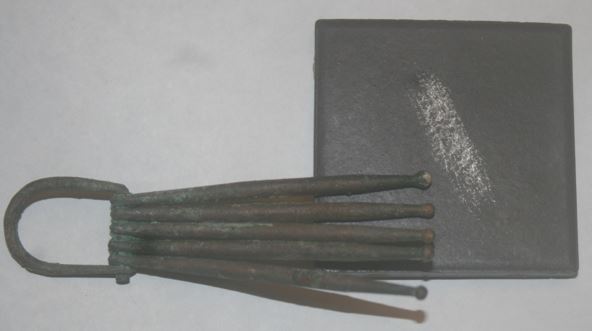
Test Pens and Rubbing Stone for Acid Testing Precious Metals.


The trouble with acid testing for precious metals.

It is not uncommon to find a ring or something that isn't marked.  It might look like silver or gold, but you might not be sure if it really is a precious metal.  In that case you need a test.

The most practical test for precious metals is an acid test kit.  You can purchase an entire kit with small vials of test acid.  Each vial will be marked with the the purity of gold it will detect.  There might also be a solutions for testing silver and platinum.

You might also receive a test stone for rubbing your item, and maybe even some test pens, which can be very helpful.  Each test pen will be tipped with silver or a specific karat gold. 

While XRF analysis will provide a more detailed analysis of your metal items, it is too expensive for most individuals.

One of the biggest problems with using test acid is that it will eventually go bad and will need periodic replacing.  Some sources recommend getting fresh acid every year-and-a-half or two years.  I've had some last much longer.  I try to buy from a source that sells a lot of it and will likely have good fresh acid in stock.

Another problem with using test acid is that you have to get down beyond the top layer, so you get to the metal beyond any corrosion or plating.  Simply applying the acid to the surface of a corroded or plated item can give false results.  When you rub the item on the stone it will leave a mark on the item, so you may not want to use this method on nice artifacts or jewelry.

After gaining some experience using test acid you learn to pretty well identify silver without applying the acid.  It will have a nice smooth feel when you rub it on the stone.  Other metals might squeak or crumble as you rub it on the stone.  

What about accuracy?  Here is what Global Bullion Suppliers says.

Acid tests have a relatively high tolerance. In other words, they are a good rough estimator of gold using the Karat scale, and even then, you shouldn't rely on it to the decimal point. Simply put, acid testing isn't always the most accurate.

Most acid kits contain materials to test 10k, 14k, 18k, and 22k gold. The acid rounds to the nearest testing solution. It will not tell you if it's 13k or 18.5k... Another problem with the acid test is that certain types of stainless steel may pass as 18 karat gold. As counterfeiting techniques are getting stronger and more advanced, it is becoming harder to spot. What we do is rely more heavily on the 14K acid and the 22K acid. That way you're testing two very different amounts of gold, rather than potentially having a murky distinction. More often than not, an acid test using 14K acid can tell the even lightly trained eye 10K gold. Likewise, a 22K acid will very clearly show you that something is not 18K whereas 18K acid is less reliable. But that's just my experience. Oh, and be sure to check that the acid is not expired.

A more technical point of not-so-common-sense is that for best results, let the acid eat into the gold. That is to say, cut into the metal or break it because the acid can't see what's inside.

(Source: How Accurate is Acid Testing for Gold? - Global Bullion Suppliers)

Obviously if you are dealing with a nice artifact or piece of jewelry, you will not want to cut into or break the item.  You might want to find someone who can do an XRF analysis on those items.

I mentioned tipped pens above.  The purpose of test pens is to give you a sample of a known composition or purity so you can compare the results.  Make a nice rubbing or two with your test pens first.  If you suspect an item might be 15K or something in that range and you have test pens tipped with 14K and 18K gold, you might make a rubbing with those pens first and then a rubbing with the item you want to test.  When you apply the acid to the metal on the stone, you can compare the reaction on the unknown item to the reaction of the 14K and 18K rubbings.  The reaction might be more similar to either the 14K or 18K rubbing, in which case you can conclude that the item is closer to either 14K or 18K.

If the reaction to the metal from the unknown item disappears more quickly than it did to the 14K rubbing, it is of lower karat and if more slowly, a higher karat.

You can also identify gold-filled items.  The acid will produce a kind of milky looking reaction to gold filled items.

Various purities of silver can be identified by different colors being produced.

---

Source: nhc.noaa.gov

We now have a fairly busy map, but with Fred up north and Grace headed towards Mexico, the one of most interest is Henri.

Henri.
Source: nhc.noaa.gov

As you can see Henri is predicted to become a hurricane and go west before turning north.  It looks like Henri will send us some waves on Friday.


Surf Predictions.

So, the four to six foot surf we'll be getting on Friday will be welcome but probably won't do much for us.  There is a lot of accumulated sand.

Happy hunting,
TreasureGuide@comcast.net


Tuesday, August 17, 2021

8/17/21 Report - Henri To Become Hurricane. Valuable Fake Gold Coins in Afghanistan. Interdisciplinary Science for Metal Detecting.


Written by the TreasureGuide for the exclusive use of the Treasure Beaches Report. 

Type of Rare Coins in Danger of Being Lost to the Taliban.
Source: see link below.

Please do not forget the Parthian Gold coins!  That is the title of a paper expressing the hope that some valuable gold coins, though fake, would not be taken and melted by the Taliban.  Below is the summary paragraph from the article.

... The Parthian coins were all made of silver, as if the Parthian had no use for gold (I do have a few of the silver ones) . If someone would come up with a gold Parthian coin, it would quickly prove to be fake. Until just before the Taliban took over Afghanistan a few decades ago, a group of archaeologists found close to three thousands of the Parthian gold coins in Talaye -Tepe in Afghanistan. Since the Afghan archaeologists knew that if the Taliban get ahold of them they would consider them idolatry and would melt them to regular gold. They hid them somewhere in the government buildings, until the Taliban were booted out of Kabul. Then they gave the coins to the new government and has been kept in a safe in Kabul museum. However this fact has been reported everywhere. The fear at this time is that if Kabul falls, the Taliban would find them and melt them to simple gold. While there is no cultural artifact in entire country of Afghanistan more valuable than the Gold Parthian Coins.

Below is the link for the complete article, which seems to me to be a translation of some other language.

Please Do Not Forget The Parthian Gold Coins - Shipping & Logistics Industry Today - EIN Presswire (einnews.com)

In reading that article I also learned of another good resource -  the Bulletin on Counterfeits.

---

If you stick at metal detecting very long, you'll continue to learn.  There is no end to it.  That is one of the things I like most about metal detecting.  You continue to discover things, explore, research and learn.

DJ sent me a link to an article on the benefits of metal detecting for seniors.  The benefits included exercise and health,  socialization, bonding with family, and picking up a little change.  Those are good things, but there is more.  There are the many discoveries and tons of questions to be answered, and there is always the puzzle of finding out where the treasure is and the best way to get it.

As I think back over the years and decades, a lot of learning took place.  I've always liked figuring things out and that is what I enjoy most these days.  There was a time when I was more interested in how much I could find, but for me it is now more about answering questions.

When I began metal detecting I read a lot about metal detecting, and I'd recommend that to anybody, but as I gained experience, observed and experimented for myself, I began to add to what I read and heard.

There are many metal detecting myths.  Like most myths they are based upon a kernel of truth, but they are not entirely true or accurate in some way.  Having that grain of truth, they can still be helpful to some extent, but there is even greater benefit to be derived from a more complete understanding.

Today I'll just briefly mention a few of the more pervasive and significant myths.   

One of the most common is the statement that heavy objects sink deeper.  As I've explained in detail before, it has more to do with density than weight, but the shape of the object is another important factor. I've written about that before so I won't get into it any more here.

A second common myth is that it is big waves that cause erosion.  Again, there is some truth to that, but it is not always true.  Big waves will not always cause big erosion.  There are other factors.  Smaller waves can cause more erosion than bigger waves.  It depends upon a variety of factors.

Another common myth is that stronger storms cause more erosion than weaker storms.  Again, there is an element of truth, but as I've detailed before, some very strong hurricanes cause little erosion while smaller storms sometimes cause more erosion.  You probably know by now that the angle of the waves have a lot to do with it, not just the size of the waves, and it helps a lot when the waves keep coming from a similar direction.  When the direction changes, recent erosion can a quickly reverse.

Reading about metal detecting was very helpful to begin with, but after a while interdisciplinary reading became most valuable.

Reading about geology or land management science, you'll learn about that the three main phases of soil erosion are detachment, transport and deposition.  Those processes are related to what I have called  "trigger points" and "drop points."   They apply equally to sand and objects.  The difference in the rate of movement is what accounts for the sifting and sorting of objects on a beach as well as "sinking," if you want to call it that.

I've also talked a lot about signal detection theory as it applies to metal detecting.  Concepts like that can be very useful for the detectorist or treasure hunter once you get enough of it to apply it.  

---

Source: nhc.noaa.gov.

Fred is now well inland and tropical storm Grace is headed towards Mexico.

Tropical storm Henri is set to become a hurricane and head north into the Atlantic.

We aren't expected to get much other than a two to four foot surf around Friday.

That is about it for now.

Happy hunting,

Treasureguide@comcast.net


Monday, August 16, 2021

8/16/21 Report - Shipwreck Holding Millions or Billions of Dollars of Gold. Pre-Prohibition Whiskey Bottle Find. Tropical Weather.


Written by the Treasure  Guide for the exclusive use of the Treasure Beaches Report.

Source: einnews.com.  See link below.


MIAMI BEACH, FL, USA, August 10, 2021 /EINPresswire.com -- Forty years ago today, on August 12, 1981, Capt. Martin Bayerle located a previously unidentified shipwreck located about 50 miles south of the island of Nantucket, Massachusetts. That unidentified shipwreck would later prove to be the Royal Mail Ship (RMS) Republic, which was what he had hoped to find after a couple of years of research. The Republic was a 585-foot long, 15,000 ton luxury liner of the White Star Line that sank in January 1909 after a collision in dense fog with another ship. Before Titanic sank in 1912, Republic had been the largest ship to sink in history. Her nickname became the Millionaires’ Ship for all the wealthy passengers she was carrying. But beyond her passengers, Republic’s sinking is notable for something much more. Within days of the sinking reports began publicly circulating that she was carrying “a large sum of money” on board, details that would soon transform into a secret treasure containing “riches beyond most men's wildest dreams.” The RMS Republic has remained a staple of treasure lore ever since. Recent appraisals by world coin experts place the prospective value of the recovery from $200 million to more than $7 billion, depending on the coin cargoes and their condition...

Well, Capt. Martin Bayerle and his team of researchers and salvage professionals are not “most men.” Republic has captivated Bayerle’s imagination now for more than 40 years. While he has had a rollercoaster ride of a life, the most recent events have been on the upswing. In 2011, Bayerle’s company, Martha’s Vineyard Scuba Headquarters Inc. (MAVIS) was awarded legal title to the wreck and cargoes by the U.S. District Court in Boston after spending decades in court. As owner, there was no longer a need to keep all his research and operations secret. In 2013, with the help of his son, Grant Bayerle (a California lawyer), the two released a book about Bayerle’s quest and research into Republic titled "The Tsar's Treasure." The book quickly generated interest by production companies and in 2015, History Channel picked up the story for a series, “Billion Dollar Wreck,” which captured the story through 9 episodes and was televised the following year in over 90 countries and seen by tens of millions of people. Since the book and series have launched, the Bayerles have focused on the big prize, setting up a company, "Lords of Fortune, LLC” (named after the ancient Roman Goddess of Luck - “Fortuna”) which is designed to make the final push for the gold, still believed after more than a century underwater to be buried deep within an undisturbed section of wreckage. Recent scans obtained by diver and maritime explorer Ben Roberts of Eastern Search and Survey support that contention. Republic, despite her age, still looks like a very attractive target for the swashbuckling investor who doesn’t mind a bit of risk...

Here is the link for the rest of that article.

Final Look at Largest Treasure Shipwreck in History While Team Prepares for Search for 110-year old Gold Coin Cargo - EIN Presswire (einnews.com)

Thanks to DJ for that link.  Below is a bit more on the same story from Wikipedia.

Brooklyn Divers was operated successfully until 1978, when the company’s source of supply and advertisements was abruptly cut off. Martin sued eight SCUBA company defendants for price fixing conspiracy under the Sherman Act and reached a six-figure settlement once the case went to trial in federal court in the Southern District of New York (Brooklyn Diver Supply Corp. v ScubaPro, Petersen Publications, Dacor, NASDS ... – and other major components of the sport SCUBA diving industry).[2] Martin then closed up his Brooklyn operations and moved to Martha's Vineyard, Massachusetts.  There he obtained a captain’s license, pilot’s license, and established Martha’s Vineyard Scuba Headquarters, Inc. (MAVIS) to serve as a base of operations to attempt to locate the fabled shipwreck of the RMS Republic.  The Republic was the largest ship to sink in history when she sank off the U.S. East Coast in January 1909 and was rumored to be carrying a vast cargo of gold.

---


Embossed Back Bar Hayner Whiskey Bottle.

This embossed Hayner Whiskey bottle was found on the Treasure Coast.  It is a pre prohibition bottle, meaning that it dates to pre-1920.  It is just over eleven inches tall.   You can see a bubble in the glass below the R in TROY.

There was a paper label between the embossed "HAYNER WHISKEY" and "DISTILLARY"

The bottom provides a lot of information.

Bottom of Same Hayner Whiskey Bottle.

The patent date is Nov. 20, 1897.

See Bottle Pickers (antiquebottlepickers.com)

---

I hate to be negative so I'll adopt the perspective of the giddy Marxist left.   The Build America Back to the Dark Ages strategy is working better than hoped as tons of fentanyl, cocaine, crime and covid are being brought into the country while Al Qaeda terrorists have been freed to revisit America to celebrate the 20th  anniversary of 9/11 and facilitate a possible reenactment, and inflation pushes the US dollar towards the value of toilet paper and the deficit skyrockets towards bankruptcy.  Don't worry - the Chinese are standing ready to pick up the pieces.

 ---


Source: nhc.noaa.gov.

Tropical storms Fred and Grace are heading away from us while tropical depression eight heads towards us a little, but not enough to help beach conditions.

Happy hunting,

Treasureguide@comcast.net


Sunday, August 15, 2021

8/15/21 Report - Tropical Activity To Watch. Found Glass Decanter and Stopper. Crystal Shell.

Written by the Treasureguide for the exclusive use of the Treasure Beaches Report.

Source: nhc.noaa.gov.

Fred seems to still be headed towards the Mobile or Tallahassee area.

Tropical storm Grace is also headed into the Gulf.

It doesn't look like we'll get any significant erosion from either of those.

The low pressure area east of North Carolina is headed south and forming.  It might do more for us than either of the others.


Tropical Storm Grace 


The surf predictions for the Treasure Coast show nothing more than a three of four foot surf lasting only one day.


Source: MagicSeaWeed.com.


Looking at the river, we're getting some waves coming from the southeast.  That could help the one spot I've been watching lately.


---


Sandsharked Decanter and Stopper.


Most mudlarked (or sandsharked as I've been calling it) bottle finds are basic utilitarian.  Some glass finds are fancier though.  Here is a cut glass decanter with a nice glass stopper.  The stopper was actually found at another time, but it its pretty well.

And the bottom of the bottle gives a lot of information.  

Bottom of Same Decanter.


The MTC maker's mark in the middle indicates the Thatcher Manufacturing Company.

You can also see a date code.  There is a 62 (though blurred) in this photo, which indicates 1962.  Its not old, but still nice.

The stopper was found at another time and place, but is also nice.


    Found Glass Bottle Stopper.


I always like finding stoppers because they often come in handy.  This one is nice on its own.  I have no idea of the age of the stopper.

Here is the information on the Thatcher Manufacturing Company.


Thatcher Mfg. Co., 1889-1946
Around the turn of the century, an Elmira lawyer named Francis E. Baldwin and a group of investors purchased Dr. Thatcher’s bottle business. Baldwin took direct control of the corporation’s daily activities in 1902 and the struggling business once again started to flourish under his leadership. In 1904, under the directive of Baldwin, the company purchased an Owens automatic bottle machine, which Baldwin had seen in action in an Ohio glass factory. At that time, Thatcher Glass had three plants located in Kane, Pa.; Ottawa, Ill. (later located in Streator, Ill); and Elmira, N.Y. The Owens machines were so successful that Thatcher Glass expanded in 1920 by purchasing four rival companies and their factories in Mt. Vernon, Ohio; Winchester, Ind.; Dunkirk and Lockport, N.Y; and Parkersburg, Cedar Grove, and Clarksburg, W. Va.

Thatcher Glass Mfg. Co., 1946-1966, and Thatcher Glass Corp., 1981-1985
Some of the Thatcher Glass plants would continue to operate for several years, with a few of the locations closing due to higher production costs. Between 1923 and 1926, the factories at Kane, Mt. Vernon, Clarksburg, and Winchester closed. In 1966, the business was acquired by Rexall Drug & Chemical Co. (later Dart Industries) and Thatcher became a division of that company. In 1981, the division was sold to Dominick & Dominick, where it operated under the Thatcher Glass Corp. name. In 1985, Thatcher declared bankruptcy and Diamond-Bathurst, Inc. acquired its remaining assets.

Here is the link for more about that.


---


Debra R. found this nice crystalized shell.


Crysatallized Shell
Photo by Dedra R.


Here is what she said.

She was wondering the type of shell.  I couldn't come up with it, although it is a common shell.   Anyone able to name it?

----

Keep watching for devvelopments with the weather.   This is the season and there is a good bit of activity out there now.

Happy hunting,

Treasureguide@comcast.net


Saturday, August 14, 2021

8/14/21 Report - Tropical Storms Fred and Grace. The Missing Spanish Crown Jewels. Mystery Object Identified.


Written by the Treasureguide for the exclusive use of the Treasure Beaches Report.

Cone for Fred.
Source: nhc.noaa.gov

It looks like Fred will become a tropical storm again and land somewhere around Mobile.  It won't help us out much.  

Tropical Storm Grace.
Source: nhc.noaa.gov.

It looks like Grace is headed around the upper Keys.  We'll see.  If it stays to the west of us, it probably won't help us much.

I was actually hoping for some more southeast swells on the river because I've been finding stuff in a dip that was created to the north of some mangroves by some southeast swells, but yesterday we had some east/northeast swells on the river that filled that filled that dip.  I looked at it this morning, and found nothing.  I'm hoping that sand will get washed out again.  I made a nice bottle find there.

The waves on the river are driven by the wind.  Even a good local rain storm can have a significant effect.

Really would like to see some beach erosion.  I don't think Grace is going to do it.  

---

Here is an item that stumped me for a long time.  I finally learned what it is.  See if you can figure it out.  It isn't an easy one.

Mystery Object.

It is tubular.  It has a bronze-like color, but gives no metal detector signal.   It came up in my scoop with a bunch of shells when I dug a target in shallow water in North Miami.

Here is are a couple more photos.  See if you can figure it out.  I couldn't, but I found out what it is.

Two Closeup Views of Same Mystery Object.

---

At the Royal Palace, no-one knew quite what to do. The king had been kidnapped by the French who moved with such speed that no-one at the palace had time to carry anything away or to hide anything. Furthermore, there was to be found there an extraordinary collection of watches and clocks as well as the fabulous set of jewels belonging to the Spanish Crown. The Governor of the Palace decided to act on his own initiative and hide these two sets of collections. He ordered that the silk hangings be detached from two rooms of the palace, and that two cavities be opened in the walls into one of which the clocks were hidden and the jewels in the other. The cavity was then mended over with embroidered silk. There was then nothing left to do but to wait for events to take their course.

The French entered Madrid and Napoleon placed his brother Joseph on the throne of Spain, but it was not to last. Revolt spread which was supported by the English. Soon King Joseph was forced leave Madrid, yet he did so not without carrying three hundred canvases of the fabulous collections of Spanish royal paintings with him. As the chronicler says: not being able to put the crown on his head, King Joseph put it in his pocket. But as for the clocks and jewels which had been hidden, the French had never found or looked for them...

Here is the link for more about the missing.Spanish crown jewels.

The jewels of the spanish crown (princemichaelschronicles.com)

Thanks to Warren D. for the lead on that story.

---

Just a reminder:  if you use acid to test precious metals, the acid has a shelf life of something like 18 months, so you will need to replace your test acid periodically.

--

The mystery item shown above is a cast of a shrimp burrow.  According to a fossil expert, the burrow filled with material and fecal pellets and hardened over time to create the cast.

---

Happy hunting,

TreasureGuide@comcast.net

Friday, August 13, 2021

8/13/21 Report - One Way Fake Coins Get Lost On The Beach. Nazi Cache Found. North Winds Expected.

Written by the Treasureguide for the exclusive use of the Treasure Beaches Report.

I showed the photo of John's find a few days ago.  I asked if it was fake or reale.  Most of you probably recognized it as a fake.  

I told John what I thought before posting the photo, but thought I'd elicit some interesting interaction from readers if I put the question out there rather than just telling what I thought, but I didn't expect what happened. 

In response to that post, Rich H. wrote the following.

I have so enjoyed reading your Treasure Beaches Report, Part 2 (and Part 1). It’s my daily Zen being land-locked in Colorado and no real beaches to speak of.


I wanted to comment on John M.’s photos of the coin he found. It’s definitely a fake. In fact my wife bought a bag of those on Amazon to bury at a metal detecting birthday party we had while visiting friends at the beach between Melborne & Sebastian Inlet in May. I’m curious if John M. found one we missed after the party.  I thought we had retrieved them all but, maybe not. I hope it wasn’t one we missed.


Here’s a photo of the “pirate” coins we used.


 Just thought John M. would like to know. Keep up the great Treasure Beaches Reports!

Best Regards,

Rich H.


Thanks for writing Rich.  It sure looks like the same type of coin.  I'll be interested to hear from John.  It would be amazing if John found one of your party coins, and we were able to connect the dots, but even if he didn't, your note provides a good example of how fake coins can end up on the beach.

Thanks Rich. 

Not only is the design unusual, but you can see the flaking surface on John's coin.

I miss visiting Colorado in the summer.  I haven't been able to go for several years, but love places like Estes and Eldorado Canyon, and being a bit of a train buff, the Durango to Silverton train ride is amazing.

Pulling into Silverton one year, I noticed a fellow dredging in a body of water just outside of Silverton.

---

Gun Found Behind Wall of House.
Source: LiveScience article.  See link below.

A history teacher found a cache of Nazi artifacts hidden behind a house wall.  The gun shown above and the badge shown below are two of the items in found in the cache.


Nazi Badge Found in Wall.
Source: LiveScience.  See link below.

The items were probably quickly discarded as American troops approaches.

Here is the link for more about that.

History teacher finds secret cache of Nazi artifacts hidden behind house wall | Live Science

---

Illustrating how those kinds of caches happen, tons of equipment and wealth is being left behind as the Afghan military flees Kandahar.  The Taliban has already seized millions of dollar of abandoned American Humvees, drones and other equipment.  What a sad sight to see those we fought with and for now in such a desperate situation.  Thanks to our woke generals.

---

Source: nhc.noaa.gov.

It looks like Fred will cross the keys and make landfall on the Florida Panhandle as a tropical storm.

The other area (red X) according to some models (ventusky.com), looks like it will bring us some northish winds towards the end of next week, most likely staying east of the Florida peninsula.  

Happy hunting,

TreasureGuide@comcast.net