Search This Blog

Thursday, July 18, 2024

7/19/24 Report - Mystery Item and Repurposed Copper Artifacts. Study on Bone Tools.


Written by the Treasureguide for the exclusive use of the Treasure Beaches Report.

Flat or Rolled Copper Mystery Item.

You can see the same item below in the palm of a hand (left).  I looks a little like the point 0small top edge) might be broken, but when I looked at it closely, first glance seemed to suggest that it might be intentionally rounded, but after looking at it at various angles, I think it could be broken. I'm just not sure.

The one surface shown below, looks very corroded, as you can see below.  The other side looks more regular.


Small Flat Copper Item.            Point of Same Item Magnified.     Surface of Same Item Magnified.


When I noticed yesterday it looked to me like it might be a small copper trade arrowhead.  I'm pretty sure I saw some of those that looked very much like that before.  I'll try to find those pictures.

One book I use a lot is The Identification Guide to Recovered Colonial and Revolutionary War Artifacts by Timothy McGuide.  It is shown below.


A lot of the artifacts are recovered repurposed or reused items, many of copper salvaged from worn out pots or whatever.  The same book shows arrowheads made of scrap, or sometimes called kettle, copper.

Here are some of the examples.

Items Made of Repurposed Copper.
1, 2, 5 and 6 are Described as Arrowheads.

That is a good book.

The mystery item looks like some bird or trade arrowheads I've seen in pictures, but at this point I'd only give it about a one percent chance of being an arrowhead.  It could be a decorative sidepiece or something.  

If you have any ideas what it might be, let me know.  Or if you can find photos of items like it, let me know.

Thanks.

---

Here is a link to an old post showing some great copper Native American finds.


---

Deer Antler Projectile Points.


Here is a brief excerpt from the article.

...

Here is the link for more about that.


I've seen what have been identified as bone points found in Florida with other artifacts.

I couldn't find where I showed them in old posts right off.

Below is a link to a post showing a nice old fossil deer tine.


---

Nothing much on the hurricane map and the local surf will remain small.

The mid0day low tide yesterday was as low as I've seen for quite some time.

Good hunting,
Treasutreguide@commcast.net


7/18/24 Report - Data Collection and Analysis for Informing Metal Detecting Strategies Relative to High and Low Value Targets.


Chart Showing Frequency of Various Value Targets.

There are always decisions to make.  Where to metal detect?  What to hunt, or in other words, what do you want to find?  How to hunt?  How much discrimination to use.  And more.

The question of where to hunt often comes down to what is close, what you know, what is easy, or where you found the most in the past.  But if you want to maximize finds, you might consider other things.

There is always the question of how you count the value of finds.  You can estimate value of what you think it will bring on the market, or you might be interested in something other than economic value.  You might be interested in other things old things, or maybe you just like certain types of things, such as maybe shipwreck artifacts.  It might have little to do with the economic value of your finds.

If you are interested in maximizing value, no matter how you evaluate that, above is a useful chart.  It is general in nature, but still useful.

Let's make it simple and go by economic value and act like that is a simple matter.  It can be either coins or jewelry or something else.

On the left and on the vertical scale is represented the frequency of targets.  On the horizontal axis is the value of targets, increasing in value as you go from left to right.

The first thing you should notice is rather obvious.  Low value targets are very common and high value targets are rare.  When it gets to a certain high value, the curve becomes pretty flat.

Some people like to find things and quickly give up when they aren't finding anything.  No targets can be tiring and make it easy to conclude there is nothing there. People give up quickly when it seems like there are few or no targets, but there might be something there and it might be valuable.  You don't know for certain unless you perfectly cover all the ground, and of course that is never possible on the beach.

Valuable targets aren't easy to get.  It can seem like they are all gong long before one shows up.  Of course, there is a natural relationship between rarity and value.

Getting valuable targets can require a lot.  It often requires going beyond what most people are willing or able to do.  

But some of high value targets will remain out there hiding.  Remember, they aren't easy to get.  Real treasures always have a dragon that guards them.  It is a challenge and should be.  Killing the dragon and the resultant personal growth is said by some authorities on mythology to be the real treasure.  

Since there is a dragon or guardian, of whatever nature it may take, that means you have to figure out how to overcome the dragon and go beyond what most others have already done.  

You will occasionally get some valuable targets hiding among the less valuable targets.  If you keep at it enough and pick up enough stuff, there is a chance something good will eventually pop up.  It just takes some patience.  

Years ago, I calculated how many coins I found for each gold ring find.  I forget what that number is now, and it varies depending upon the place and other factors, but I once knew the numbers for the places where I frequently hunted.  I kept good enough records to have some good numbers.

Of course, that number was different for different situations.  For example, I do remember that the number of rings found in the water per coin was generally considerably higher than on land.  And of course, the numbers varied on different beaches as I think I mentioned the other day.  Some beaches simply produce more rings than others, and some beaches produce more higher quality rings than others.  And some beaches produce a lot of coins and very few rings.  I've mentioned some of the important factors related to that in the past.

People often behave and detect in a way that would suggest that what they most want to find is clad coins.  They are shaped by the reward of the adrenalin and activity of digging targets even if those targets aren't really great.  It keeps them going.  Again that is OK, but not always the most economically productive strategy.

One thing that should be considered is how valuable a great find can be.  A great ring can run thousands of dollars, for example.  Or a royal escudo can be so valuable that it is worth putting up with a lot of no-target days.  The hard thing is to persevere while not finding much of anything until you find that high value target that will drastically out weight all the small value targets you might otherwise get.  

If you intentionally target high-value finds, you will not necessarily find much else. Some places have a good mix of coins and gold. Sometimes there is some gold where there are a lot of coins but some places there are good high-value targets such as gold but almost no coins.  

If you do your research and analysis and have reason to believe there is a good chance of high value finds in the area, it can be worth putting in a lot of time just to find one high value targets that can be of much more value than tons of low value targets.

One Rolex or one nice escudo can be worth thousands of smaller value targets.  If you have reason to believe there might be a high value target in the area, you might want to put in a lot of time on the site even realizing you might not hit it.  I would put up with a lot more time with no signals if I was in a high-value target area.  It is worth it.  And very often the highest value target areas do not produce a lot of junk or low value targets.  

Let's for a minute limit the discussion to rings   A small value ring is not worth nearly as much as a great ring with great gemstones.  You can find a hundred small value rings that together will not be worth one great ring.

At some beaches you might expect mostly 10k bands, whereas at another beach you might expect some great and valuable rings, but probably a smaller number.  Do the math.  Figure out the expected average value of the type of target you are most interested in finding.  What is the probability, or the expected number, and what is the average expected value.  If you do the math, you can compare a beach that produces more low value rings with a beach that tends to produce on average more high value rings.  That will help with your analysis.  Of course, your expectations need to be informed, so the more experience and data you that at those beaches, the better your calculations or expectations will become.  Once again, lower quality and higher value targets require more data collecting to get a good estimate or expectation.  And when you are hunting a particular or one-of-a-kind item you must generalize from other data. 

Here are a few concluding points. Be clear about what you are targeting and why. Adjust your decisions and strategies according to your target and the situation.  Make adjustments as you collect data.  Be aware of the trade-offs. Select sites based upon your best data and estimates and don't underestimate the value of high value targets.

Here is a link to the post where I originally posted the chart shown above.

The Treasure Beaches Report Direct From Florida's Treasure Coast.: 7/10/14 Report - The Math of Metal Detecting and How It Can Assist Decisions and Strategies

Not everybody will have the desire to conduct such a systematic analysis, but if you have the inclination, it can help inform your strategies and decisions.

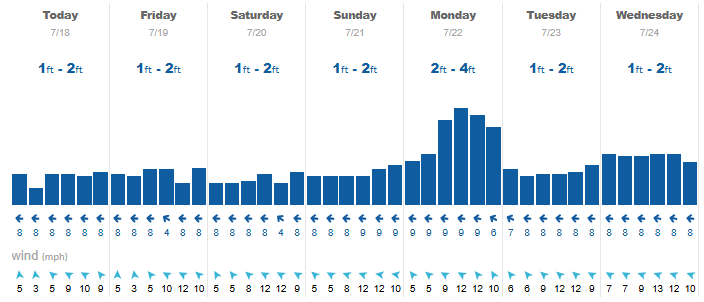
Fort Pierce Area Surf Chart From Surfguru.com.

Notice the one little bump.  Something like that isn't very significant, but it might cause a slight change of plans for the day.

Nothing on the National Hurricane Center map for us to be concerned about right now.

-

Did you ever wonder why when there is someone towards the beginning of a waiting line and a bunch of other people show up and join them, why it is the late comers join the group at the front of the line rather than the front group joining their late friends at the end of the line.  That is how I think it should work.  Why should arriving late give you the privilege of jumping line?  I can accept when a person or two might have been in the group and had to leave momentarily before returning, but that is not always the case.

---

Good hunting,

Treasuregudie@comcast.net

Wednesday, July 17, 2024

7/17/24 Report - Inverted Cross: Popularity and Meaning. Amazing Emeralds. Tips for Selecting Jewelry Beaches.


Written by the TreasureGuide for the exclusive use of the Treasure Beaches Report.

Cross Being Worn Inverted.


For centuries, the inverted cross, with the horizontal crossbar at the bottom instead of the original one at the top, was considered a Christian symbol, based on an ancient tradition that the apostle Peter was crucified upside down.

Saint Peter was crucified during the reign of Emperor Nero, around the year 67...

So the upside-down cross, sometimes called the Cross of Saint Peter, became a symbol of humility and was then associated with the Pope, known as the papal cross–to the point that the Popes have used it regularly, although with more reluctance in the last two pontificates...

Because when the Masons took power, and from them the Satanists, the symbolism of inversion of Christianity became predominant.

Occultists used the same Christian symbols to connote the opposite in order to confuse Christians and make their task of sabotage within the Catholic flock more efficient.

And today we are seeing the popularization of the inverted cross.

As society degenerates into a modern form of Sodom and Gomorrah, the inverted cross symbol has become more prevalent...

Forums: About The Inverted Cross (spiritdaily.org)

---

Did you hear about the Ambani wedding?  Hundreds of millions of dollars was spent on one of the most extravagant weddings ever.  Here is the link for more about that.  Anant Ambani and Radhika Merchant wedding: Celebrity guests arrive for lavish star studded ceremony | CNN

After wearing emeralds the size of “popsicles” for the pre-wedding celebrations, Nita decked herself once again in the auspicious emerald stone for her son’s ceremony. A collection of sizable emeralds in pear, over, brilliant, and round cuts adorned her necklaces, bindi-pieces, nose-ring, earrings, rings, and bracelets...

There are of course legendary Indian emeralds. "Among the most renowned are the jewels of the Maharaja of Baroda, including the celebrated 'Star of India' emerald. Another exemplary piece is the Mogul Mughal emerald, a remarkable rectangular-cut emerald from the 17th century, weighing approximately 217.80 carats and inscribed with sacred texts," third generation jewellery dealer Lee Siegelson tells T&C.  (The Most Dazzling Jewelry From Anant Ambani and Radhika Merchant’s Wedding | Vogue)


Mughal or Deccani emerald, dated AH 1107/1695-6 AD. The rectangular-cut emerald known as 'The Mogul Mughal' weighing 217.80 carats, the obverse engraved with Shi'a invocations in elegant naskh script, dated 1107 A.H., the reverse carved all over with foliate decoration, the central rosette flanked by single large poppy flowers, with a line of three smaller poppy flowers either side, the bevelled edges carved with cross pattern incisions and herringbone decoration, each of the four sides drilled for attachments,
2 1/16 x 1 9/16 x 7/16 in. (5.2 x 4x 1.2 cm.) (
Christies)

---

Yesterday I talked about metal detecting gold rings on the beach.  Here is some things I said about that years ago.

Fact 1. Some cultures and groups wear more gold than others. That is obvious but take advantage of that knowledge and hunt beaches where the people who wear the most or best gold gather.

Fact 2. Wealthier and flashier people tend to wear better jewelry than poorer and less ostentatious people. That is not always true because some wealthy people do not wear much good gold while there are some poorer groups that do wear good gold. 

Given the choice between hunting a beach with a lot of low-quality jewelry versus one with higher quality jewelry, I would often take the beach with the higher quality stuff even if the finds are less frequent. Some beaches have a lot of gold but some of those beaches will have predominantly lower-quality 10K or plated gold or silver rather than 14K or 18k gold, for example. 

Fact 3. Tourists tend to lose more gold than locals. First, tourists often do not want to leave their valuables in the car or hotel and so unlike locals are more likely to wear their good stuff to the beach. Also, tourists are not as aware of how easily gold can be lost in the sand or water.

Fact 4. Young active people usually lose more jewelry than more mature people. It is often the diving, hand-stands, cart-wheels and other youthful carelessness that leads to many of the loses.

Not taking beach or water conditions or other factors into account, you will find more gold where young active wealthy careless people, tourists and people from gold wearing cultures gather frolic. South Florida has beaches where all of those factors come together to create some great hunting.

Many factors should be considered for selecting a beach for finding gold jewelry.  The factors include socio economic and cultural.

----

Nothing new on the hurricane map and no big changes in beach conditions.

Good hunting,

TreasureGuide@comcast.net

Tuesday, July 16, 2024

7/16/24 Report - Ringing Them Up One At A Time. Revolutionary War Era Musket Balls.


Written by the TreasureGuide for the exclusive use of the Treasure Beaches Report.


A rare and precious ring has been discovered during archaeological excavation by the National History Museum in the citadel of the mediaeval fortress Kokaliansku Urvich, the National Archaeological Institute at the Bulgarian Academy of Science said on July 11.

The find was made in grave Νο 9, dug into the floor of a mediaeval burial church, directly into the rock.

Preliminary observations have led to the theory that the ring was the property of an aristocrat who lived in the second half of the 14th century.

The eagle depicted is a symbol of the royal power at Veliko Turnovo during the Middle Ages.

This suggests that the ring may have belonged to one to the family of the Bulgarian king Ivan Alexander...

So far, 12 graves have been discovered, four of which were well marked. Two of the graves were robbed in the 16th c., judging by the fragments of a silver adornment in the heap above it, the institute said.

The researchers believe that the ring was on the hand of the departed and that the rosette on it symbolizes continuity and ancestral memory.

Here is the link.

Archaeology: Rare and precious ring found at mediaeval fortress site in Bulgaria – The Sofia Globe

I'm often amazed how many rings are out there to be found.  You can find them everywhere  

Of course, there are some places where you can find more.  And there are some places where you can find more expensive rings, and some places where you can find older rings.  But you can find rings almost anywhere.  

I've said this before, but the first time I detected an old trail in a woods in West Virginia, I found a gold ring.  People told me there was nothing to be found there.  But there it was.  It was a 1940s high school class ring.

But that wasn't all.  On the steep wooded hills I found more rings.  They weren't gold, but there were rings.  I expected rings on Miami beaches, but didn't expect so many rings in the West Viriginia hills.  There weren't so many, but there were certainly more than I expected.

More rings and more expensive rings are found in South Florida.  And more rings are found in the water than on the beaches.

It depends upon where you are.  You'll find different kinds of rings different places.  For example, in the lakes of Minnesota there weren't a lot of rings.  People don't wear as much jewelry up there.  At least they didn't back then.  Think about it.  It is cold and rings are inconvenient when you wear gloves. 

There was also more silver up there than gold.  I didn't find the kind of glitz in Minneso that I found in South Florida.

But individual beaches that aren't very far apart will be different too.  For example, Hollywood beach would produce a good number of rings, but they are generally not as expensive as those found at som e of the Miami spots. There were more 10K rings than higher karat rings at Hollywood Beach.  

I also always warn that you have to make sure you aren't passing over rings without detecting them.  When I first started finding rings, I thought women didn't lose many rings.  It turns out that I was using some discrimination and missing a good number of the smaller lady's rings, which are the ones with good gemstones.  I found that out after I cut down the discrimination.  Then I learned that women lost just as many rings as men.  And the women's rings were often more valuable.   

Rings won't always give great signals, depending upon a variety of factors including their position in the ground.  Some can easily be missed.

Now people are wearing a lot of other kinds of rings.  Sometimes steel or even silicon.  

My point is that rings can surprisingly be found almost everywhere even though they will vary in quality and value depending upon the area.

---


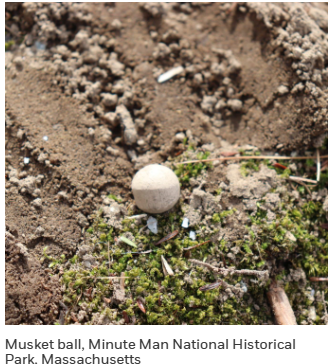
According to a WBUR report, five musket balls were unearthed near the North Bridge at Minute Man National Historical Park, marked as the site of the beginning of the Revolutionary War. On April 19, 1775, British troops opened fire on colonial militia members who were crossing the North Bridge. The militia members returned fire and charged under the orders of Major John Buttrick of Concord, routing the British troops. The recovered musket balls are thought to have been fired by the colonial militia during the short battle. “It’s incredible that we can stand here and hold what amounts to just a few seconds of history that changed the world almost 250 years ago,” said historic weapons specialist Jarrad Fuoss of Minute Man National Historical Park. For more on archaeological sites in the park...

Here is that link.

News - Colonial-Era Musket Balls Uncovered in Massachusetts - Archaeology Magazine

---

The Parker’s Revenge Archaeological Project has been working at the 44-acre site in Minute Man National Historical Park to reconstruct the events and landscape of the eighteenth-century encounter. They have employed a number of archaeological methods, including excavation, geophysical survey, 3-D laser scanning, and metal detection. Relying on the principles associated with battlefield archaeology, researchers are using retrieved musket balls, both dropped and fired, to determine the location of the combatants and the intensity of the fighting...

Here is the link for more about that.

Digs & Discoveries - Finding Parker’s Revenge - Archaeology Magazine - January/February 2016

---

Nothing new with the weather or beach conditions.  Good water conditions continue.

Good hunting,

TreasureGuide@comcast.net

Monday, July 15, 2024

7/15/24 Report - History of Spanish Colonial Gold. Cruddy Pennies by the Load.


Written by the Treasureguide for the exclusive use of the Treasure Beaches Report.


Here is an excerpt from a good article.

... In ancient Colombia, gold was also revered for its lustre and association with the sun. In powdered form, gold was used to cover the body of the future Muisca (Chibcha) king in a lavish coronation ceremony, which gave rise to the legend of El Dorado ('Gilded Man'). The newly dusted monarch then leapt into Lake Guatavita in a ritual act of cleansing. Meanwhile, onlookers threw precious objects into the lake as auspicious offerings to the gods. By the time the conquistadors had heard rumours of this ceremony in the 1530s, the story had been embellished, and El Dorado had become not a man but a great city paved with gold.

The golden city was never found because it did not exist, but attempts were made to find out just what lay at the bottom of Lake Guatavita. In the 1580s Antonio de Sepúlveda had perhaps the most ambitious scheme when he cut a slice out of the lake's crater edge in order to drain it and find the treasure which must surely have accumulated on the lake bed. Some gold artefacts were indeed found, but before the lake could drain completely a landslide blocked the cut, and so the water level began to rise again. A long line of sorely disappointed adventurers has since followed with their, so far, unsuccessful attempts to extract gold from Lake Guatavita...

Here is the link for more about the gold of the conquistadors.

The Gold of the Conquistadors - World History Encyclopedia

---

Mark G. just reached a milestone.  Below is what he said.

I have just completed my first year of metal detecting and filled my first jar of coins, enough to tumble. Like we all know zinc pennies don’t do well in the surf so now I have a half jar full of useless money. I took my jar of zinc pennies to the bank Friday to redeem them for good pennies and they said they don’t do that and directed me to the department of engraving or better known as the US Mint. I discovered there is a path to redeem these coins as scrap metal by the pound. Good news bad news the program had been suspended for 2 years due to China flooding the coin recycling market however good news it may be back up and running or getting ready to restart I cannot actually find definite answer to that. Now my 1 pound of pennies might not be worth the postage for shipping, however if a bunch of detectorists or even a club pooled their coins and made a big haul to the mint they could donate the money to the clubs favorite charity or whatever.


The US Mint will buy the coins by the pound only with prices different for the different denominations ($20 per pound for quarters and dimes, $1.81 for a pound of pennies, $4.53 for a pound of nickels).  It’s quite simple. Just bag up the damaged coins — sorted by denomination — and send them to the Philadelphia Mint:


United States Mint

Independence Mall
P.O. Box 400
Philadelphia, Pennsylvania 19105

Link to US Mint:

Mutilated Coin Redemption Program | U.S. Mint (usmint.gov)


Anyone have an ideas?

A pound of copper is worth $4.58 and the pre 1982 pennies were 95% copper.  I've mentioned before, people have been hoarding copper pennies for a long time.

Copper coins, such as the penny, started as pure copper, but rising copper prices led to changes in composition. In 1857, the Mint added nickel to the copper, but switched to tin and zinc in 1864. For the year 1943, pennies became zinc-coated steel because copper was essential to the war effort during World War II.

I keep my wheat pennies.

---

I'm glad the president wants to cut down the divisive language, so he'll be stopping what you see in this link.

Trump defense team plays video of Democrats 'inciting' language | IMPEACHMENT TRIAL (youtube.com)

Some confusion out there about the Republican registered shooter contributing to leftist organization.  You should recall that Democrats were registering Republican so they could vote against Trump in the primaries.  Deceptive sorta like the false hat operation at the Capital Bldg.

---

Nothing on the National Hurricane Center map, and the surf remains smooth.

Good hunting,

Treasureguide@comcast.net


Sunday, July 14, 2024

7/14/24 Report - Water Hunting For Hot Weather: A Few Tips. A Few New Bottle Finds.


Written by the TreasureGuide for the exclusive use of the Treasure Beaches Report.


Treasureguide Coming Up With Gold Chain.

The photo at the top of yesterday's post reminded me of one of my favorite photos.  I'm talking about the one above.  It was taken years ago.  By the metal detector, which is a Fisher 1280, I'd say it was at least twenty-five years ago that the picture was taken.   I remember that chain too.

When I went to look for that photo, I discovered a post that is still very relevant for today.  Since the weather has been so hot the past couple of months, you might find water hunting much more comfortable.  It keeps you cooler even when you are just wading.

Below is part of that old post.


I generally like to be as free as possible. That means not too much equipment or specialized gear. I want to be flexible and able to walk into the water or up onto land without changing equipment or anything. I therefore often use just the basic equipment that will work well both in the water and on land and nothing extra.

Sometimes though, if you go out knowing that you want to be in the water you might find some of the gear you see in this picture helpful.

The wetsuit can help maintain body temperature on cold days. It can also help protect your skin from pests such as Portuguese Man-O-War or sea lice. Also, of course, it protects your skin from the sun.

I found the Man-O-War to be a more common problem in South Florida than on the Treasure Coast even though they do show up on the Treasure Coast from time to time.

The snorkel and mask can be helpful at times. One of the advantages is that it can help you see the bottom better. That can help you see items and better see the bottom conditions and treasure traps, including things such as dips or pot holes.

One of the things I don't like about wearing a mask is that I feel less aware of my surroundings, both visually and aurally. I also don't like carrying it around if I decide to exit the water or go into very shallow water.

A weight belt can help even if you don't wear weights because you can strap equipment such as pouch or snorkel mask to the weight belt when you are not using it.

One advantage of snorkeling is that unlike the optometrist that fell into the lens grinder and made a spectacle of himself, you can work near crowds without drawing as much attention to yourself. Most people won't see what you are doing and won't ask as many questions while your head is in the water. On the other hand, it might be more difficult to keep an eye on them.

I might or might not choose to use a scoop when snorkeling, depending upon the situation. When not using a scoop, I'll either hand or foot-fan.

There are advantages and disadvantages to both wading and snorkeling. I like to be flexible enough to change quickly on the fly.


Yesterday I had some time to take a little walk to see what I could find. It was hot but the water was calm and visibility was great.

Aqua THE A 1 SAUCE Embossed Bottle.


The first thing I found was a pair of old binoculars that someone had dropped in the water.  They looed like they had been in the water for quite a while.  Later I found a couple bottles.  The one shown above is the first of those.  It is an A1 Sauce bottle.  Below is what I learned about it.


Here is the link for more about A1 sauce.

A1: a history of Brand & Co - Let's Look Again (letslookagain.com)

The A1 bottle is interesting because of the embossing, but the bottle doesn't appear to be real old.  I found an older bottle, which is shown below.  it is well over a hundred years old.  It is a blown bottle with some nice bubbles and a lot of stretch marks around the neck.

R & Co. Bottle.

This blown aqua bottle is most likely a beer bottle.  The only mark is the manufacturer mark R & Co. on the bottom, which indicates the Reed Co.  As you can see from the chart, this bottle would be earlier than 1904. 

This bottle does have a maker's mark on the bottom - R & Co. which indicates the Reed and Co.


Here is a link for more about that.


I also picked up an older unmarked crown top bottle, but it was machine made.  I like blown bottles better.  

---

Back when the Ukraine war began I quit using the phrase Happy Hunting.  It just didn't seem too frivolous when people were being killed like they were.  I didn't feel right using it.  Things haven't improved.  Recent events make me sad for our country.  

Pray for peace.
TreasureGuide@comcast.net


Saturday, July 13, 2024

7/13/24 Report - Found: Venetian Glass, Trumpet Parts, Historic Foundation. Analytical and Intuitive Thinking Combined.


Written by the Treasureguide for the exclusive use of the Treasure Beaches Report.


A total of 112 whole and fragmented glass vessels, likely dating back centuries, were found in June 2024 during underwater archaeological work in Chengene Skele Bay in Bulgaria’s Bourgas district, the Regional Historical Museum Bourgas said on July 9.

The archaeological work was done by a team from the National History Museum led by Professor Ivan Hristov, and involved dives in five areas in different parts of the bay.

The discoveries in June this year follow the finding of dozens of fragments of glass objects in the bay in 2020 and 2021.

It has been suggested that the glass may have been a cargo spilled from a boat or ship during a storm and high swell.

The probability that the wreckage of the vessel carrying the glass vessels is near the location of the discovery of the glass fragments is very high, the Regional Historical Museum Bourgas said.

The basis for this hypothesis is provided by several fragments of iron anchor chains and highly fragmented ceramic vessels found underwater, bearing traces of ceramic production characteristics of the Late Middle Ages and the Renaissance...

Here is the link for more about that.

---


...bronze trumpets made in the Dutch city of Leiden have been found in the cargo of a sixteenth-century Dutch shipwreck in the Adriatic Sea, near Croatia’s Cape Kamenjak. “The trumpets were being transported in pieces,” said Luka Bekić of Croatia’s International Centre for Underwater Archaeology. “We can see that when looking at the number of these parts, and we know that there were more than ten of them. There are only less than ten trumpets from the sixteenth century in well-known museums across the entire world,” he explained. Beads and ceramics were also recovered from the shipwreck, which was likely transporting a load of grain to Venice when it sank. The site is being recorded with photogrammetry so that a digital model of it can be made, added team member Roko Surić. The ship’s three cannon will remain on the seabed...

Here is that link.


---

Historic home foundation located.

... Mansfield is thought to have been born in the early eighteenth century in West Africa, then enslaved and trafficked across the Atlantic Ocean. He was eventually freed in New England, where records show that he bought two acres of land in 1762 and constructed a stone house. The site of the home had been lost over time, however. Mansfield is known to have hosted hundreds of free and enslaved Black people at his home in an annual event known as “Black Election Day,” where he was elected to the title of “King,” and entrusted to handle important matters for the local Black community, nearly every year until his death. The structure discovered at the site matches the descriptions of Mansfield’s home found in the historical documentation. “The big find was the handmade pebble foundation without quarry rock,” said Meghan Howey of the University of New Hampshire. Large stones were usually purchased for foundations, but the use of river pebbles, she explained, indicates that this home had been built by a self-reliant person without access to a quarry...

And here is that link.


---

When trying to make sense of the world around us we do not perceive every small component.  You can look for individual elements, such as erosion, shells, or high waves, and each one might provide a clue or a sign, but you can also see the overall situation as an integrated complex system.  As they say, "The whole is greater than the sum of its parts."  The individual elements fit together in relation to each other forming a scenario that if you've been metal detecting for many years will create recognizable patterns.

Unfortunately the most "stand-out" scenarios or situations are truly exceptional and all too rare.   You might remember the time the dunes were cut to create an eight-foot cliff, as was the case a few years ago at certain locations.  That is a rare event, but what makes it really stand out is when there is also truly exceptional hunting with a seemingly endless number of good, or great, targets.

Those types of events stick in your memory.  You remember many details, not just the cut, or the waves and tides during and after the event, or the slope of the beach in front of the cut, or the rocks or shell piles exposed, or even the wind and rain, but also the finds.  

The most memorable days for me are varied.  Some were shallow water days.  Some were high beach days.  Some were days crowded by many detectorists flocking to the same beach while others were days when I was the only one on the entire beach.  Some were stormy days while others were beautiful sunny days.  They are special unique days, and you can spend years or even decades hoping to see the same situation again.  It forms an indelible multi-sensory image that you may never see again.  See The Treasure Beaches Report Direct From Florida's Treasure Coast.: 11/11/19 Report - History Between the Pages of Old Books. Memorable Metal Detecting Experiences.

When you walk out onto a beach you might first of all notice a particular feature such as the shape of the beach or the amount of sand or erosion.  You might see particular features or elements, but if you just stand there and let your mind take in the everything, your mind will put it all together.  

Look for the individual features and take them in, and test your hypotheses, but then slow down and quietly stand there for a few seconds, letting your mind work to put it all together until you get that peaceful feeling that seems to intuitively lead you.  At one level you will consciously and analytically assess the situation but at another level your mind will synthesize the data.  That way you will get the best of both worlds.

---

The Treasure Coast tides are moderate and the surf still small.  Nothing on the NHC map right now.

Good hunting,
Treasureguide@comcast.net