Search This Blog

Sunday, November 21, 2021

11/21/21 Report - Some Spots of Erosion and Some Older Stuff Being Dug.


Written by the TreasureGuide for the exclusive use of the Treasure Beaches Report.

Just a brief message for now.

Sunday afternoon there was at least one spot where the beach was down to old sand and old bits of lead and things were being found.  Some are in cleaning now.

I didn't get hardly any pictures because of the rain.  I had my chance, but was going to take pictures later, but then there was a thunder storm.

The productive spots are few and far between.  Yet they are out there.

Not many detectorists out today.

The sand level around the first flag pole at Turtle Trail had decreased some since yesterday, but not by a lot.   There was one area where some of the orange/brown sand was barely covered and the old lead splatter was being found there.

I wouldn't be surprised if a few cobs were found this weekend.

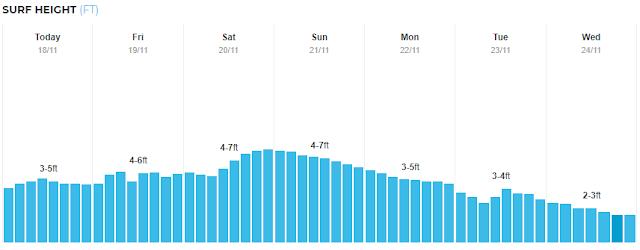
The surf will be decreasing through tonight and tomorrow.


Source: MagicSeaWeed.com.

Happy and Wet Hunting,

Treasureguide@comcast.net


Saturday, November 20, 2021

11/20/21 Report - Higher Surf and Some Detectorists Out Saturday. Beach Conditions.

 Written by the TreasureGuide for the exclusive use of the Treasure Beaches Report.

One Detectorist at Wabasso Saturday Around Noon.

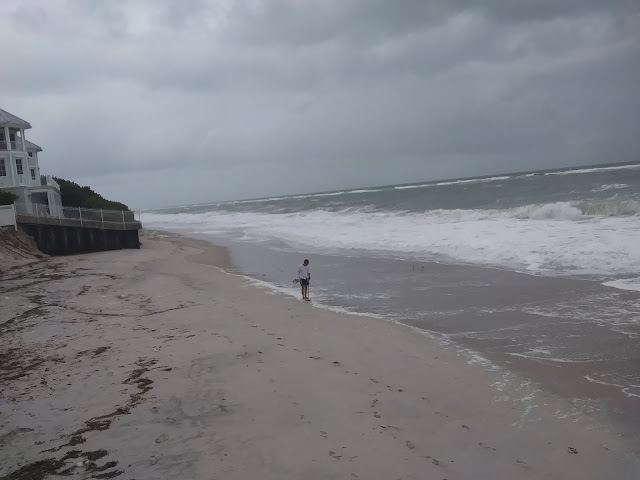
I took a look at a couple beaches today.  The surf was higher, but the waves were hitting directly from the east.


Wabasso Around Noon Saturday.


Not a lot of new sand loss at Wabasso.


Turtle Trail Saturday Before Low Tide.


At Turtle Trail there was very little cutting.    At around the first flag pole, only the very tops of the bags were showing and the two posts I've been using were pretty much covered by sand.  The front slope looked a little steeper but I was too early to get very far out.


Turtle Trail Before Low Tide Saturday.


Between the second and third flag pole (counting the first, which is now on the ground) the most bags were showing. 


South of Turtle Trail Saturday.

These were about half the way between the second and third flag poles, if I correctly recall.

JamminJack showed these same bags exposed back days ago.

The surf is supposed to be a bit higher tomorrow.


Surf Predictions for Sebastian Inlet.

---

I saw some photos of three nice reales that were found back on the ninth.

===

Florida Covid cases are way down.


Africa, where few people have been vaccinated has very little Covid.  Much of the population there has had hydroxychloroquine.  Too bad the ex-pres mentioned it, and it is so cheap that the drug companies make very little off of it.

---

Happy hunting,

Treasureguide@comcast.net


Friday, November 19, 2021

11/19/21 Report - Higher Surf Coming But Limited Sand Moved So Far. Gold Coins Analyzed. Seeing the Unseen.

Written by the Treasure Guide for the exclusive use of the Treasure Beaches Report.

North of John Brooks Beach Friday Afternoon.


I took a look at a few beaches this afternoon just before low tide.  As you can see there was some scalloping and cutting, but not much.  The water was rough, but it was not hitting at a good angle.

Here are some other views.


Looking North From John Brooks


There were some targets on the beach including a few modern coins and miscellaneous bits junk.


John Brooks South Friday Afternoon.


Walton Rocks Friday Afternoon.


Walton Rocks Friday Afternoon.

---

Several ancient Roman coins were analyzed. Below is part of what the lead author concluded.

We know that the Romans deliberately surface enriched their silver coins to 'hide' the fact there was a lot of copper in them, so it is plausible something similar happened to the gold. Our work at ISIS enabled us to sample the very center of these coins totally non-destructively and conclusively show that the high purity seen on the surface was representative of the composition of the 'core' of the coin. At a basic level it is further testament to the economic health of the Roman Empire, but these conclusions are also useful for researchers who need to employ non or negligibly-destructive techniques on the surfaces of Roman gold coins. Now they can be confident the surface is representative of the bulk of these objects."...

Here is the link for more about that.


---


The illustration above comes from an interesting but too short article that presents some interesting ideas.

He makes four points:

  1. Spatially “there is far more world, more cosmos out there than your eyes can even approximately capture” Whether it is the expanse of the earth–I can’t see what’s going on in Swaziland– or the trillions of galaxies. Even with the best cameras and telescopes and satellites there is far more than you can see.
  2. Chronologically – there are thousands-yea billions of years which we can never experience or see, but the effects of those events are real and there is even more unseen in the future.
  3. Scientifically – In addition to Gamma Rays, X Rays, Radar, Radio Waves, Shortwaves etc.  we accept that there are quadrillions of atoms buzzing within and around us but you can’t see them. Light itself is not something you can see. You see things because of light, but light itself is invisible. We can’t see the electromagnetic radiation that operates our cell phones or, for that matter, the electricity that powers our lives. Father Paine goes on to point out that science itself tells us that only 5% of matter is the stuff we can experiment on. 95% of “dark matter and energy” remains mysterious, invisible and unidentified. 95%!!

He concludes, “Thus on a material basis alone, any scientifically enlightened view of reality must concede that beyond the tiny slice of cosmos we are able to perceive there is incalculably more that is unseen.”

Here is the link.

On Seeing the Unseen | Fr. Dwight Longenecker

Metal detecting is all about trying to detect, or sense, what is below the sand and therefore unseen.

Many scientific advances involved methods of seeing the unseen.  The microscope and telescope would be examples.

---

Source: MagicSeaWeed.com.

The surf is predicted to be a couple feet higher Saturday.

Happy hunting,

Treasureguide@comcast.net


---


Thursday, November 18, 2021

11/18/21 Report - Largest Metal Detecting Coil. 5,500 Ancient Silver Coins Found. Stone Balls. Bigger Surf.


Written by the TreasureGuide for the exclusive use of the Treasure Beaches Report.

5,500


More than 5,500 silver coins buried by a river about 1,800 years ago are now in the hands of archaeologists, following the hoard's discovery in Augsburg, Germany...

Archaeologists found the hoard earlier this year in an old riverbed. But though the coins were scattered in the newly dug pit, that likely wasn't how they were originally placed. "The place of hiding was probably washed away many centuries later by a flood of the Wertach river, scattering the coins in the river gravel," Krmnicek said...
 

Here is the link for more about that.

Massive hoard of Roman-era silver coins unearthed in Germany | Live Science

---

Metal Detector Coil 115 Feet in Diameter Carried by Helicopter

He’s looking for the key minerals — cobalt, copper and nickel — that go into the batteries that can power clean energy technologies, particularly the incoming demand from electric vehicles.  That is why in August he watched as a helicopter flew past with a massive metal detector swinging beneath it, scanning a vast section of this remote Canadian wilderness.

The device, akin to a giant dream catcher at 115 feet across and weighing 1,700 pounds, peered a third of a mile into the earth by using an electromagnetic current. The data it collects is key to trying to speed up what has traditionally been the slow, painstaking process of mineral discovery...

Here is that link.

Mining the gap: Companies push to find raw materials for electric vehicle boom (nbcnews.com)

---

A few days ago I was talking about artifact interpretation and mentioned a stone ball.  I mentioned a few alternative interpretations.  I ran across an article about natural objects that can look like cultural artifacts.  One in particular was relevant to the stone ball.

Natural Objects that Masquerade as Cultural Artifacts | The Office of the State Archaeologist (uiowa.edu)

And here is an article on geology that explains how stones can get caught in potholes where water movement washes them around until they are round.

See Potholes (mtu.edu)

Here is an illustration from that article.

Rock Being Rounded in Pothole.

I might expand on that in the future.  

Helpful article.

===

Source: MagicSeaWeed.com.

Today's surf was  3-5 feet, tomorrow supposed to be something like  4 -6, and Saturday, something like 4 - 7.  

We'll see how that goes.

Happy hunting,

TreasureGuide@comcast.net

Wednesday, November 17, 2021

11/16/21 Report - Florida Experts At International Convention of Historians and Numismatists. Bigger Surf Predicted.


Written by the TreasureGuide for the exclusive use of the Treasure Beaches Report.

Source: See Popular-Archaeology link below.

When the primary cultural deposit – the motherlode – of the 1622 fleet galleon Nuestra Señora de Atocha was discovered by divers working for treasure hunter Mel Fisher near Key West, Florida in 1985, among its riches was a vast cargo of silver coins the likes of which had never before been seen. The discovery also delivered a bombshell surprise of evidence for historians: confirmation that hand-struck silver coins were produced in the Nuevo Reino de Granada – today’s Colombia  – as early as 1621, a fact that some had suspected, but none had proof to substantiate.

This year, from December 1 to December 5, 2021, 400 years after the conflict-ridden establishment of minting houses in both Cartagena and Santa Fe de Bogota, coin experts and history enthusiasts from all over the world – including six from Florida – will gather in Colombia’s romantic seaport city for “Cartagena MMXXI – the 3rd International Convention of Historians and Numismatists” where they will examine and celebrate this fascinating point in time along with other key moments in numismatic history...

Here is the link for more about that.

400-year-old twist of fate uniting Cartagena, Colombia, and Florida Keys history to be celebrated – Popular Archeology (popular-archaeology.com)

---


Photographs take of the Seagrape Trail area by DJ Tuesday Morning. 


JamminJack was out Tuesday too.   Here is what he said.

More easterly and enough wind to keep the water up on the beach. Low was at 11:30am, and looked like mid tide. 

The conglomerate is probably from a sea bag. This is what my machine pick up when sand is lower. Hot rock, but pull machine few inches and hit not as strong. Could be old concrete with a rebar in it. The washer, and nails is plentiful, but I would dig because the non ferrous object was acting like iron...

And here are some of the things he dug.


---

Just when I started to think the Oak Island TV show was becoming a little more reasonable, I hear a lot of baloney.  So now the show is looking even more hoaky or dishonest than ever before.  

Here is just one example.  Recently, while channel surfing I saw a few minutes of the show.  A round stone is found.  Immediately the round stone is interpreted as being a cannon ball that was shot onto the island from a ship's cannon.  So after a few minutes I could hardly bear to watch any more.  Could the round stone not be a Native American healing stone? Or NA sling shot?  Or game piece?  Are there no other reasonable possibilities?  Of course there are if you take just a minute to actually think.  Instead of interpreting the evidence from a conclusion, let the evidence lead you to a conclusion, and consider and test alternative interpretations.

If you have a dock and road, why does it have to be that the dock and road were used to unload treasure to be buried on the island?  Roads go both ways.  Could it be, as they so famously say, for harvesting lumber, tar, pigs or whatever.  I appreciate the more reasonable approach of the archaeologists.  Too bad there is so much of the absurd stuff, which if intentional, is dishonesty.  The show could actually be watchable.

----


Fort Pierce Surf Predictions.
Source: MagicSeaWeed.com


Sebastian  Inlet Predictions.

The predictions have been fluctuating.  The last time I looked Fort Pierce had up to nine feet predicted.  That has come down some.  Hope it doesn't decrease any more.

Happy Hunting,

TreasureGuide@comcast.net


Tuesday, November 16, 2021

11/16/21 Report - 30-Year Gold Hoard. The Many Lives of Lead. Bigger Surf Coming.


Written by the TreasureGuide for the exclusive use of the Treasure Beaches Report.


More than 130 gold coins unearthed by metal detectorists from a field in west Norfolk over a period of almost 30 years have been declared the largest hoard of such items from the Anglo-Saxon period found in England.

The 131 coins, as well as four other gold objects dating to 1,400 years ago, were sporadically discovered between 1991 and 2020, but it was only on Wednesday that an inquiry deemed them to be part of the same hoard.

Most of the objects were found by a single anonymous detectorist who reported his finds to the relevant authorities. However, 10 of the coins were found by David Cockle, a serving police officer who was 
jailed for 16 months in 2017 for illegally trying to sell them. Two of the finds concealed by Cockle have since disappeared into the antiquities trade...

Here is the link for more about that.

Norfolk treasure newly declared as England’s biggest Anglo-Saxon coin hoard | Heritage | The Guardian

---

One of the most common old finds made on the Treasure Coast includes musket balls, which have been found by the hundreds.  A simple object like a musket ball can open up a world of history if you take the time to meditate on it.  Think about the people who made it, used it and how it was lost.  Think about what those people were doing and their place in history.  And even think about the lead, where and how it was mined.

I found a great web site that lays provides the history of lead mining and production and the miners.  It provides many illustrations and other learning resources.

Here is the link.

Lead Production in the 18th and 19th Centuries • Lead Mining in the Yorkshire Dales • MyLearning


Very good read.  Highly recommended.

---

One of the most interesting things about a lead musket ball is the many possible lives it lived.  Here is a great example of how an item can have a surprising history.


PHILADELPHIA, JULY 6, 2017 — Just hours after the words of the Declaration of Independence were first read to the army in New York on July 9, 1776, a mob of soldiers and sailors descended on Bowling Green in Lower Manhattan and tore down the gilded statue of King George III that stood there.

Pieces of the statue were later melted down into more than 42,000 musket balls – referred to as “melted majesty” by some – and used to fight the British during the Revolutionary War. One of those musket balls is now on display at the Museum of the American Revolution in time for the July 9 anniversary of the tearing down of the statue.

In 2015, nine musket balls that had been previously excavated at the site of the June 28, 1778 Battle of Monmouth in N.J., were found to have strong probabilities of being from the statue based on elemental analysis...

Here is that link.

“Melted Majesty” Musket Ball Discovered at Monmouth Battlefield to be Displayed at Museum for July 9 Anniversary - Museum of the American Revolution (amrevmuseum.org)


Being malleable, lead was often melted or otherwise reformed into needed items time and time again.  A musket ball might be turned into a fishing weight, toy soldier or any of a large number of useful items to meet a need.

---

I noticed a book on the subject of musket balls that you might find useful: Musket Ball and Small Shot Identification; A Guide. by Daniel Sivilich. 

JamminJack mentioned the Dixie Gun Works catalogs as a good reference for lead shot and related items.

---


Source: MagicSeaWeed.com.


Higher surf still predicted for the weekend.

Happy hunting,

Treasureguide@comcast.net

Monday, November 15, 2021

11/15/21 Report - Laundry List of Treasure Beaches To Consider Metal Detecting. Don't Get In A Rut.


Written by the TreasureGuide for the exclusive use of the Treasure Beaches Report.

I'm going to try to do something that will be difficult for me.  I woke up thinking about the many places I've metal detected and especially those that have produced shipwreck treasure coins.  It is easy to get in a rut, but there are always new places to explore.  I'm going to give you a laundry list of beach sites that I've detected that have some possibility of producing shipwreck treasure coins when the timing is right.

Men are like lab rats to a large extent.  Many of the same principles apply.  Reward and punishment are powerful factors for men and mice alike.

People tend to hunt most where they've made finds and they find the most where they hunt most, so it  becomes something of a self-fulfilling prophecy.  If you believe a location is a good one, you will hunt there more, and as a result you will probably find more there.  But as you spend more time on the locations where you have been successful in the past, you can miss some other locations that might be just as good or better.  The world changes, and beaches change, so to remain successful, you have to change and adapt.  I recommend the book, Who Moved My Cheese?, which was a best selling book for  business people that talks about the necessity of changing strategies in a changing world.  What worked best in the past won't always work best in the future.

Beaches change over time, which means detectorists also need to change.  A beach that has been productive for along time can become less productive because of natural or man-made changes.  \

Two of the biggest factors in my metal detecting success formula are  time-on-task and location.  Most people will tend to hunt closer to home.  Travel is time consuming and is becoming more expensive.  If you have a good location to detect that is also close to your home, you have a big advantage.

When I lived down south I mostly detected from the Keys to Pompano Beach and later on occasionally made quick trips to the Treasure Coast.

I've detected only a few times in the middle to lower Keys.  Outside of what I read in books, I had little knowledge of those beaches and there was a low probability of success.  It helps to know a beach well, so driving to a distant location and taking a blind shot at a beach you don't know very well is a low probability proposition, but it can be fun and occasionally productive.  I think it is a good idea to become familiar with a lot of sites and add them to your list of possibilities.  

Key Biscayne was a shorter drive for me when I lived down south, and I liked to detect there.  I got to know it well and was able to visit frequently and whenever the conditions were promising.  Key Biscayne was a lot of fun after Hurricane Andrew.  Treasure coins had been found on Key Biscayne and at other beaches around there.

I avoided South Beach, but detected a lot of Dade County above there.  There are some old shipwrecks around that area, including a couple around Haulover, but the good modern items around there were plentiful as well.  Talking about beaches changing, though, one of my favorite detecting areas for modern items was near Haulover.  That beach is now covered with a few hundred yards of sand.  When I was down there and detecting there a lot, it was cut way back so you could find years of accumulated finds even if they were modern.

Most all of the Dade and Broward beaches provide good detecting, but I'll skip over some.  Silver shipwreck coins were found around Hillsboro Inlet and Pompano Beach.  Also around Boca Raton Inlet.

Jupiter Beach, as you probably know, has produced reales.  It was a very fun beach, but a good drive for me.   I haven't been down there for quite a while.   I don't know if I've been there since 2004.  Maybe once, but I used to stop there when I lived down south and traveled to the Treasure Coast.  As you probably know, they dumped a lot of sand on that beach in recent years.  It used to be much more natural.  A fun place to detect for both modern and shipwreck treasure.

I never detected Juno.  Not for any particular reason.

I used to detect Jensen a lot but haven't been down there much in recent years.   Check out the book Treasure Coast Gold.  It is a novel, but there is truth behind the fiction.  The research for the book is based upon some interesting facts that would interest any treasure hunter.  The author used to pitch his book in a book store, in the Treasure Coast Mall.  He had some interesting historic maps and research material.   

There are some interesting places between Jensen and Walton Rocks, but I'll skip to Walton Rocks.  There is a more modern wreck to the south and to the north, as you probably know, is the Power Plant Wreck.

Then there is Frederick Douglass and John Brooks.  Very good beaches, that seem to be in a slow period - I think largely because of all the renourishment sand being dumped south of the Fort Pierce Inlet.  At the north end of Brooks, it was cut way farther back at one time.   I remember one time it was cut all the way back to the trees right in front of the condos to the north.  There was a line of tree stumps at the water line and a concrete foundation was uncovered - maybe belonging to the WW II observation tower.  I didn't see it right after the 2004 storms.  I missed that because of other responsibilities.  

The there is Pepper Park, which has been pretty sandy for a while.

Sandy Point is a very long walk.

Rio Mar was once cut back much more than now too.  It was nicely eroded maybe ten years ago or more.  

A lot of detectorists don't know that cobs have been found right in front of the Holiday Inn in Vero.  I remember watching the grass in front of the Holiday Inn fall into the water during one rough spell before cobs were found there but don't remember which storm that was.  It was quite a few years ago.

The Turtle Trial, Seagrape, and Wabasso, and up to the Sebastian inlet are all heavily detected these days.

I haven't done Golden Sands and Treasure Shores much but good things have been found there.

Bonsteel Park is frequently detected but I don't go there much anymore, simply because it is farther from home.  As I said, I cut down on my ranging in recent years.  I don't have a lot of time to detect, so cut down on my traveling. 

I've never detected Melbourne, which of course is a good area for Treasure Coins.  Some of the more interesting salvage finds from this season were made up there.

I also always enjoyed detecting areas other than the Treasure Coast when I did business travel and detected Pensacola and the surrounding area a lot but made mostly modern finds there.  It was always fun though.

I won't mention more distant domestic and international sites now, but the point is there are a lot of places to detect and they can go through hot and cold periods, so don't be afraid to explore.  And don't get too focused on one or two beaches.  You'll never know when a beach that hasn't done anything for you in the past will get hot.

There is one beach I detected a lot in the past without much luck that suddenly produced some exciting finds just last year.  Don't write off a beach just because you didn't have any luck right away.  Some beaches can conceal their prizes for a long time before you hit it just right.  You might then have a new favorite beach.

It is a dilemma.  You can't be everywhere and you have to make your choices.  You can play the hot spot, which is a good strategy, but things will eventually change, and you will need to change too at some point.  

---


Source: MagicSeaWeed.com.

A smooth surf can allow you to get farther out than you could when the surf was bigger.  That can be just what you needed, especially if you have some good low tides too.

It looks like we'll have some bigger surf next weekend.


I often see people fishing on the beach but not catching much.  I noticed lately that there were a lot of fish being caught.  JamminJack mentioned the same thing.

Happy hunting,

Treasureguide@comcast.net


New clues from studying historical non-returning boomerangs (cosmosmagazine.com)