Search This Blog

Sunday, March 20, 2022

3/20/22 Report - Collection of Charles and Joanna Coins. Seminole Milk Co. And Other Bottles. Consider Sifting.


Written by the Treasureguide for the exclusive use of the Treasure Beaches Report.


About the Clyde Hubbard Collection of Charles and Joanna  Coins To Be Offered by Sedwick Coins.
Source: Sedqick Coins Email.

You might remember that there were some Charles and Joanna coins found on the Treasure Coast back a year or two ago.

I keep thinking maybe I already posted the above, but can't find it right now, and it won't hurt to post it again if I didn't.


-----


Newly Dug Seminole Milk Company Bottle
Jacksonville, FL.  Circa 1927.


This bottle reads as follows. 

HALF PINT
LIQUID
PROPERTY OF
AND CONTAINS
MILK OR CREAM
PASTEURIZED AND BOTTLED
BY
SEMINOLE MILK COMPANY
JACKSONVILLE, FLA.

 
It was not easy to get a good photo of this bottle.  Maybe I can get a better photo.  Even when the bottle is well lit and well positioned, the embossing has so many words that with the curvature of the bottle you can't capture all the text in a single photo.

The bottle is in great shape.  No cracks or chips.  It also has some great grip bumps around the neck.

The maker's mark is a 5/W, which indicates Winslow Glass Works, circa 1912 - 1927.  I read elsewhere that the Seminole Milk Company operated 1926 - 1936.  I'd place this bottle around 1927.  Great piece of Florida dairy history.

Thursday I took a little walk and found the two bottles shown below.  I was surprised to find them.  I saw very little that was even close to anything good or old until I picked up the brown bottle, which isn't anything great, but it is old.  Then I saw a moss covered lump about two feet away that looked about the right size and shape, and when I picked it up and discovered it was also a stopper-top bottle.  Again, nothing great, but I was surprised to find any old bottles and doubly surprised to find two within a foot or two of each other.

Then Friday, if you remember that old pepper tree I started to remove before spotting a piece of an old Atlantic Coast Lines serving plate, my wife started to uncover the roots of the same tree so I could cut them.  That is when she found the bottle above.  Now that is a nice bottle - much better than the two I found the day before when I went out looking for old bottles. 


Two Recent Stopper-Top Bottle Finds.

I went back to check out the holes around where my wife found the Seminole Milk Company bottle.  I stuck my coil in the holes she dug and worked around the area a little more.   After finding nothing in the holes or dirt, I expanded my search area a little more.  I detected a lot of iron, which I mostly discriminated for the time being and picked up a few items.\

One appeared to be a flattened copper tube with some cutouts.  I found the following information on it.

ADLAKE PAT. APR 27, 1909.


That was helpful.  I quickly found information on the Adams and Westlake Company.  They make a lot of railroad signal lights.

Here is a very good link if you are interested in Railroadiana.  

Adams & Westlake 1907 Catalog - Railroadiana Online

So I'm back on the railroad trail again.  

I saw in the catalog that Adams and Westlake also made locks very much like the one I found and posted last year.

My wife saw something about the Seminole Milk Company having a contract with railroads.  I didn't pay much attention to that until I found this piece with a 1909 date also being a railroad related piece.  I'm now thinking there is a good chance the flattened copper tube is from a signal light.

I also found a small button that was covered with blue cloth.  It took me a while to come up with it, but I'm now thinking it could be the kind of thing you'd find on the top of a hat or cap.  Nothing significant, but figuring things out is a part of the process that I like. 


I also found some hefty nails and a 22 long bullet.  

I often say there is always somewhere to hunt and something to find, and I keep finding that to be true.  I haven't had much time to drive to any of my favorite beach hunting sites, but have been enjoying finding older things close enough to my home, that I don't have to spend time in travel.  I keep finding stuff, although no gold coins, within walking distance from my home, and I keep being amazed by how much there is buried.  Besides the metal items you can detect, there are a lot of older items that you can dig up.  It takes a lot of work, but the amount of items keeps amazing me.  If you never really covered your yard well, or the areas close to home, I'd say give it a try.  You might not turn up any gold coins, but you never know what you will find until you look.  When you get a few minutes, you can give it a try.  I'll bet there is more there than you think.  

I did some posts on sifting.  You can find non-metallic items that way, but not only will sifting increase non-metallic finds, it will also increase your coin finds.  There are coins that you will find sifting that you will not find with your metal detector, for any of a variety of reasons.  

I did a post about four years ago, that shows what can be accomplished when you use a sifter.  Russ found over four hundred coins on a single lot.  He told what he found metal detecting on multiple sessions and also what he found sifting after metal detecting.  This is a very instructive post, and if you haven't read it, you definitely should.


---

We are having some good tides now, but not much surf.

Good hunting,
TreasureGuide@comcast.net


Friday, March 18, 2022

3/19/22 Report - Detectorist Takes Family Detecting and Finds Very Valuable Coin. Treasure Trails of the West. Full Moon.


Written by the TreasureGuide for the exclusive use of the Treasure Beaches Report.

Source: See TheGuardian link below


A metal detectorist who gave up his hobby when he started a family, only to return to it when his children were old enough to nag him into taking them out detecting with him, has been rewarded with one of the most extraordinary finds – a fine example of England’s oldest gold coin, which has sold for a record-breaking £648,000 at auction.

Michael Leigh-Mallory, 52, found the Henry III gold penny buried 10cm deep on farmland in the Devon village of Hemyock shortly after taking up his old hobby again. Not realising what it was, he posted a picture of the coin on social media, where it was spotted by the auctioneers link in London.

He will split the proceeds of the find with the landowner and plans to use his windfall to help fund the future education of his children, history-loving 13-year-old Emily, who has ambitions of studying archaeology at university, and Harry, 10.

Here is the link for more about that.

‘I owe it to the kids’: coin found by detectorist dad sold for £648,000 | Devon | The Guardian

----

You might enjoy browsing the February 2022 Holabird Auctions Western Trails and Treasures catalog. 

For some of the highlights, visit Silver Ingots Pique Bidder Interest at Holabird’s February Reno Auction | CoinNews.

It isn't the Spanish stuff that is sought so much on the Treasure Coast, but some really cool treasures, including silver ingots, mining tokens, and even a cool mining car.  Below are just two of the many examples.


Here is the link to the entire auction catalog.

February 2022 Auction Catalog (pubhtml5.com)

---

I'm sure you love it - four dollar gas (just the beginning), empty shelves at the market, sky-high grocery prices and rent, censorship, authoritarianism becoming the norm, and now on the brink of nuclear war.  Its all part of the transformation of America that we were clearly promised.  Get used to it or change it. 

He answered them, “When it is evening, you say, ‘It will be fair weather, for the sky is red.’ And in the morning, ‘It will be stormy today, for the sky is red and threatening.’ You know how to interpret the appearance of the sky, but you cannot interpret the signs of the times. Matthew 16:3 

---

We had a beautiful full moon last night.  On rising it was yellow where I was.  You could see the shadows almost all night long.  We are getting close to the spring equinox, so the tides are showing it.

Unfortunately the surf is stuck on two or three feet for the next few days.

Easter is late this year because it occurs on the first Sunday after the first full moon after the spring equinox, and this full moon occurs shortly before the spring equinox.


Good hunting,
TreasureGuide@comcas.net

3/18/22 Report - Hoard of Maravedis Found. Values of Maravedis. Secret of Maravedi Cove.


Written by the Treasureguide for the exclusive use of the Treasure Beaches Report.


The 1715 Fleet provides the lucky detectorist with silver and even occasionally some gold coins, but there is another kind of Spanish colonial coin that is found on rare occasions.  It isn't the cargo of Spanish treasure fleets, but the small change of the day - the Maravedi.  When found, maravedis often come from salvage camps in the dunes or land archaeological sites.

After Spain's discovery of the Americas, copper maravedís, along with silver reales, were the first coins struck in Spain for the purpose of circulation in the New World colonies. These coins, minted with a special design for specific use of the Americas, were first coined in Seville in 1505 for shipment to the colonial island of Hispaniola the following year, thus giving these coins their distinction as the first coins for the New World. By 1531 these coins were still being minted, by now in both Seville and Burgos. These maravedís were used as Spanish Colonial change for smaller transactions and after mints were later established in the New World, in both Mexico (ordered in 1535, production began in 1536) and Santo Domingo (ordered in 1536, production began in 1542), coins of this type were also minted there. (Wikipedia)


About ten years ago a hoard of coins, mostly copper pieces, were discovered by a metal detectorist near a major Spanish settlement on the east coast of Florida.  You can probably guess which, although the author didn't tell.  

The detectorist, "is an avid local historian, a capable researcher who does his homework with books and maps before he ever turns a spade of soil. This fellow had found a pretty good spot to find items from the Spanish era in soil disturbed by modern development. While hardly virgin soil, it still kept many of its secrets from about 400 years ago."


The lion’s share of the coins found in this hoard were from the 17th century, with just a few 18th century and later pieces. Nearly all were copper, small bronze pieces struck on the Spanish mainland denominated in maravedis. The largest of these, worth 8 maravedis, was essentially equal to a quarter real in silver, making it a small but useful unit. The most frequently found denomination was a 2-maravedi piece, a small bronze coin that composed just a 1/136 part of an 8-real coin.

While most of the small bronze coins circulating in Spain in the 17th century were countermarked in a series of mid-century coinage revaluations, relatively few of the countermarked pieces were found in the hoard, suggesting that the coins had been imported to America prior to the 1641 and 1652 countermarking acts.

Spanish copper coins from the 17th century are found up and down the Eastern Seaboard, one here, one there, suggestive of the need for small change in early America and the frequent commercial intercourse between the British colonies and the Spanish dominions of the Caribbean and South America. They’ve even been found at Jamestown...
Here is the link for more about that.

Treasure finds in Florida (coinworld.com)

Here are the values of maravedis as provided by Coinquest.


1 MARAVEDI (15 mm diameter, 1.12 grams)
worn: $15 US dollars approximate catalog value
average circulated: $40
well preserved : $60
maravedi dated before 1772 are larger and worth more, double these values


2 MARAVEDIS (20 mm diameter, 2.45 grams)
worn: $7 US dollars approximate catalog value
average circulated: $25
well preserved : $45
2 maravedis before 1789 are larger
2 maravedis dated 1782 are rare and catalog at $220 in well preserved condition
2 maravedis dated 1783 are somewhat rare and catalog at $100 in well preserved condition

4 MARAVEDIS (25 mm diameter, 5.41 grams)
worn: $8 US dollars approximate catalog value
average circulated: $20
well preserved: $36
4 maravedis dated before 1772 are quite rare and catalog at $500 in well preserved condition
4 maravedis dated 1783 are worth more, cataloging at $115 in well preserved condition

8 MARAVEDIS (30 mm diameter, 12 grams)
worn: $6 US dollars approximate catalog value
average circulated: $15
well preserved: $35
8 maravedis dated before 1772 are rare and catalog at $500 in well preserved condition
8 maravedis dated 1772, 1782, 1783, and 1792 are worth more, cataloging at about $130 in well preserved condition

And here is that link.

Coin Value: Spain 1, 2, 4 and 8 Maravedis (Carol III and IIII) 1770 to 1808 (coinquest.com)

---

The Story of Maravedi Cove.

This is a good read.  It tells of the chance discovery of what was found to be a maravedi and the attempt to relocate and further search the area where the maravedi was originally found.

Here is just the beginning.

A Small Coin Reveals a Big Secret
In the early 1980s, Grand Turk dive operator Mike Spillar was cruising around the islands, diving with some friends...

Here is the link.

Maravedi Cove – Turks and Caicos Museum (tcmuseum.org)

---

Good hunting,

TreasureGuide@comcast.net


Wednesday, March 16, 2022

3/17/22 Report - 16th or 17th Century Bow Found. Wood From Pilgrims Ship. Increasing Tides.


Written by the TreasureGuide for the exclusive use of the Treasure Beaches Report.


National Park Service employees made an unlikely discovery in the backcountry of Lake Clark National Park and Preserve in Alaska this past September: a 54-inch wooden hunting bow that was found under 2 feet of water, but still intact.

Scientists and archeologists are analyzing the hunting bow in an attempt to learn more about its origin and history. According to radiocarbon dating conducted by the NPS, the bow is estimated to be 460 years old, ranging in origin between 1506 and 1660. The real mystery lies not in how old the bow is, but where it came from...

Here is the link for more about that.

460-Year-Old Hunting Bow Discovered in Alaska | Outdoor Life

---


In 1626, a ship foundered in stormy seas and wrecked on Cape Cod, where the passengers were aided by the local Indigenous population and the Pilgrims in nearby Plymouth.

Now the most in-depth scientific analysis of timbers found more than 150 years ago has provided the best evidence yet that they belonged to the ill-fated vessel known as the Sparrow-Hawk.,,

The timbers have long been assu..med to be from the roughly 40-foot (12-meter) Sparrow-Hawk — the oldest known shipwreck of English Colonial America — based largely on where they were found, but there always remained some uncertainty...

Here is the link for more about that.

New analysis provides more clues about Pilgrim-era shipwreck | AP News

---


Source: magicseaweed.com


The tides are getting bigger, but the surf doesn't look very promising.

Good hunting,

TreasureGuide@comcast.net


3/16/22 - Valuable Coin Found by Detectorist. Charles and Joanna Coin Collection. Treasuring Ideas.


Written by the TreasrueGuide for the exclusive use of the Treasure Beaches Report.


A rare 14th century 'leopard' coin worth $185,000 was found by an amateur metal detectorist in a field. 'I did the gold dance,' he said...

In October 2019, at the end of a long, dispiriting day, Andy Carter made a startling discovery. A retired scientist, the 65-year-old had joined 30 other amateur treasure hunters combing over a muddy farmer’s field in Norfolk, England. Most had begun to pack up after failing to find anything of significance.

Around 3:30 p.m., Carter’s metal detector pinged. He dug down about ten inches into the mud, uncovering a small gold coin...

“When I brushed off the soil, I saw the hind leg of a big cat,” Carter tells the Guardian's Harriet Sherwood. “I thought, ‘It can’t be a leopard.’”

As it turned out, the feline engraved on the 23-karat gold coin was indeed a leopard. Known as a leopard florin, it was minted under Edward III and sold at auction yesterday for £140,000 (around $185,000). Counting the 24 percent buyer’s premium, the coin’s total sale price was £173,600 (around $228,885...

Here are a couple links for more about that.

Amateur Treasure Hunter Unearths Rare 14th-Century Gold Coin | Smart News| Smithsonian Magazine

Also

https://www.businessinsider.com/england-leopard-gold-coin-worth-185000-found-by-metal-detectorist-2022-3


Thanks to William K. and Rick B. for those links.

---

Daniel Frank Sedwick is proud to announce the first selection of coins from the Clyde Hubbard Collection of Charles & Joanna Coinage, to be auctioned May 4-6, 2022. Lot viewing will take place at the Central States Numismatic Society convention April 27-30 in Schaumburg, Illinois – as well as before and after the show by appointment at Sedwick’s offices in Florida.,,

 His [Clyde Hubbard's] collecting work on Charles & Joanna coinage is immortalized in his collaboration with Robert I. Nesmith, whose landmark book The Coinage of the First Mint of the Americas at Mexico City, 1536-1572 (1955) was largely based on Clyde’s near-comprehensive collection of those coins.

We are honored to present this collection now in a series of multiple auctions, starting with a choice offering across the full Charles & Joanna period and continuing in future auctions with Clyde’s cobs as well. The initial selection of 135 pieces in our May 4-6 auction is all graded by NGC and features many “finest known” and unique varieties, with Hubbard’s all-important pedigree preserved on the labels. Cataloged by our own Cori Sedwick Downing, whose die-study work on Charles & Joanna coinage is becoming known as a much-needed update to Nesmith, this first offering will be an important reference and mark the birth of a new generation in an eminently collectible field with generally well-made coins and abundant varieties. Join us in making Mexican numismatic history!

See Sedwick to Feature Clyde Hubbard Collection of Charles-Joanna Coinage (coinweek.com)

You might recall that a few Charles and Joanna coins were found on the Treasure Coast in November of 2020.  There was some good hunting back then.

---

There is no greater treasure than a great idea.  I'm always seeking good ideas and information.  The most valuable ideas are those that change how you see yourself or the world. 

Ideas should be evaluated.  They must stand on their own.  They should be rigorously evaluated.  Censored ideas can not be fairly evaluated.  Censorship is  an ill-advised attempt to keep poor ideas from standing on their own merits.  It is the tool of those who can not or will not present convincing arguments in the market place of ideas.

Surprisingly, ideas don't have to be completely true in every respect to be helpful.  Ideas having some basis will be refined and improved over time.

I once believed that coins were uncovered but not washed up onto the beach. I saw a lot of evidence of how coins were uncovered by erosion.  It worked for me.  It led to a ton of coin and ring finds.  

I know now that coins are also washed up onto the beach, although it occurs much less often.  It happens less frequently, and I had less direct evidence because it happens less frequently and is difficult to observe.  It took me longer to understand precisely how and under what circumstances it happens.  My understanding increased over time and I expect it to continue.

Hunting for ideas and information is much like hunting for treasure.  Some sources are better than others. You couldn't possibly listen to all ideas, and you try to use your time well.  You learn where to look and who to listen to.  You stop listening to some people. You give them a chance, but after a while they prove to be poor sources.  You look where you feel you are most likely to find something worthwhile.

Again, ideas don't have to be entirely true to be worthwhile, especially creative ideas that stimulate the imagination.  Those are very rare too, but they can lead you to new insights.  You might wonder what if it was true, or what if you tweaked it a little here or there.  

In short, I'm all for ideas being out there to be considered and evaluated.  You might find they are false, partly true, or be completely true.  They can also tell you something about the person that put them out there.


---

The tides are getting bigger, but the surf will be down around two or three feet for a few days.

Good hunting,

TreasureGuide@comcast.net

Monday, March 14, 2022

3/15/22 Report - Newly Renourished Beaches Open Again. A Surprise Find of Florida Tourism History.


Written by the TreasureGuide for the exclusive use of the Treasure Beaches Report. 

Entrance to Turtle Trail on Monday.


Wabasso and Turtle Trail accesses were open on 3/14.  Thanks to Jim M. for these photos showing the newly renourished Wabasso and Turtle Trail beaches.


Looking At the Beach Access Stairs at Turtle Trail Monday.

That is one pile of sand.

Looking North at Turtle Trail.


Looks like it will be a while before it gets eroded back to the dunes again.


Looking South At Turtle Trail

Jim found Wabasso Beach open too.

Wabasso Beach Entrance Monday.


Looks like the area to the north at Wabasso might erode again before long.


Looking North From Wabasso Beach Access Monday.


Looking Towards Disney Resort.

Thanks much Jim.

---

I went out with the intention of cutting a huge Pepper tree.  I spotted an old brown whiskey bottle laying under some brush.  That got me distracted, and I was on the hunt again - this time for glass.  I saw one piece, so thought there should be more.  I scratched around a little and found a few broken pieces, and then, partially covered at the base of a tree, I saw the piece shown below.


Piece of a Large Dinner Plate.


I turned it over to look for some markings, and was pleased to find more than I expected.


Section of Atlantic Coast Line Railroad Serving Plate Showing Marking.

The plate reads: Ye Old Ivory Buffalo China - Flora of the South - Hibiscus, Jessamine, Poinsettia - Made especially for Atlantic Coast Line Railroads.

The piece shown in the first photo shows part of the poinsettia.

Too bad it isn't whole. I found a whole one for sale online for $120. 

Still I like having the piece, which tells the story of passenger service from New York and points North to Miami.

We don't have that kind of passenger service these days.

I'll be looking for more of this plate.  It is probably there somewhere.

The Atlantic Coast Line Railroad is a former U. S. Class I railroad formed in 1900, though predecessor railroads had used the ACL brand since 1871...

The Atlantic Coast Line served the southeast, with a concentration of lines in Florida. Numerous named passenger trains were operated by the railroad for Florida-bound tourists, with the Atlantic Coast Line contributing significantly to Florida's economic development in the first half of the 20th century.

At the end of 1925, ACL operated 4,924 miles of road, not including its flock of subsidiaries; after some merging, mileage at the end of 1960 was 5,570 not including A&WP, CN&L, East Carolina, Georgia, Rockingham, and V&CS. In 1960, ACL reported 10,623 million net ton-miles of revenue freight and 490 million passenger-miles.


---

Source: MagicSeaWeed.com.

Nothing exciting again.

I have a lot more lined up for future posts.

Good hunting,

TreasureGuide@comcast.net


3/14/22 Report - Changing Beach Landscapes. Triangulation Markers Of By-gone Days. Marking and Positioning.


Written by the TreasureGuide for the exclusive use of the Treasure Beaches Report.

Old Anchor Along South Indian River Drive.


I decided to go take a look at the beach Sunday.  Here is John Brooks.


John Brooks Beach Sunday Around Noon.

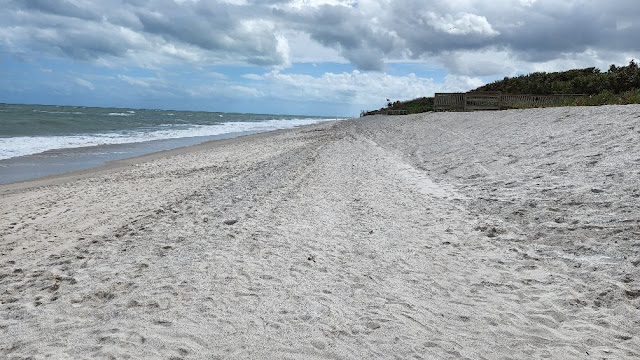
As you can see there wasn't much erosion.  There were some small cuts at the curve to the north.


John Brooks Beach Sunday Around Noon.

And you can see just a little erosion to the south.


John Brooks Beach Sunday Afternoon.

The slope wasn't very firm.

---

Changing Landscapes.

I don't know how long ago it was, but in the trees or dunes opposite a treasure salvage site, there used to be big square (mostly) signs with letters painted on them.  I guess it might have been maybe twenty years ago.  I know there were just a few remaining more recently than the others.  

If you've been around very long, you probably remember some of those markers.  The ones I remember most clearly were at John Brooks and Frederick Douglass.  Many were in dead Australian pines.  As I recall, the markers were red or orange with big white letters on them.  The Australian pines, which are considered an invasive species, were removed from John Brooks and Frederick Douglass parks.

If you don't remember those old markers, in the days before everybody was using GPS, they were used by salvors to triangulate their position.  I wish I had a photo handy to show some of those.   

---

I used to use triangulation a lot myself, mostly when water hunting is South Florida. 

Usually you can find some kind of markers to use.  A single line is enough to help some, although it won't give you the precise point.  Trees, rocks, telephone poles, docks, houses, or whatever can all be used.  It is not real precise, but it can help.  If you can line up a tree stump with a rock, or something like that, it is enough to put you on a line, which can be a big help by itself.  Sometimes a single marker will help, especially if you can remember the angle.  I'm pretty good at the angles.  

Sometimes, if I find something I don't want to carry a long distance, I leave it to pick up on the return trip.  I'm really bad at that though.  I often get tuned into hunting again, and pass by the item that I left to be picked up.  Sometimes I'll leave a big line or X in the sand, and still pass it up.  Sometimes the mark will get erased by the water by the time I return, so it has to go up safely into the dry sand.

If you are just digging coins, you won't need to leave much behind, but if you are picking up something like bottles, you might not be able to carry them all.  And if you put them in plastic shopping bags, all it takes is for two bags to swing together, and inevitably it is the best bottle that breaks.

===

Source: MagicSeaweed.com

Nothing special in the surf predictions.  The tides are starting to increase a little, but so far, barely.

---

John 11:32 - 35.

32When Mary reached the place where Jesus was and saw him, she fell at his feet and said, “Lord, if you had been here, my brother would not have died.”

33When Jesus saw her weeping, and the Jews who had come along with her also weeping, he was deeply moved in spirit and troubled. 34“Where have you laid him?” he asked.

“Come and see, Lord,” they replied.

35Jesus wept.

---

TreasureGuide@comcast.net